Yes, a driver who is not telling the truth can be exposed, and the strongest proof usually comes from evidence that cannot change its account, meaning vehicle damage patterns, event data recorder downloads, camera footage, and independent witnesses. New York also gives you a version of record, because Vehicle and Traffic Law Section 605 requires every driver in a qualifying crash to file a signed written report, the MV-104, with the DMV within 10 days. New York applies pure comparative fault under CPLR 1411, so every percentage point of blame the other driver shifts onto you cuts your recovery by that same percentage. This article explains where the proof comes from and how to preserve it before it disappears.
At William Mattar, P.C. our team has focused on motor vehicle accidents for more than 30 years, with attorneys and offices across New York State.
Key facts about disputed fault in New York car accidents
- Under CPLR 1411, your damages are reduced by your percentage of fault, which is why a false account almost always aims at that percentage. A recent change in the law can significantly impact your case. Speak with an experienced attorney as soon as possible.
- The MV-104 driver report includes a signed crash description and a diagram, which makes it your version of record in an official file.
- Event data recorders and business security cameras often overwrite their data within days or weeks, so preservation requests need to go out early.
- A police report is not final. It can be supplemented or corrected, and your own MV-104 filing is one way to put your account on paper.
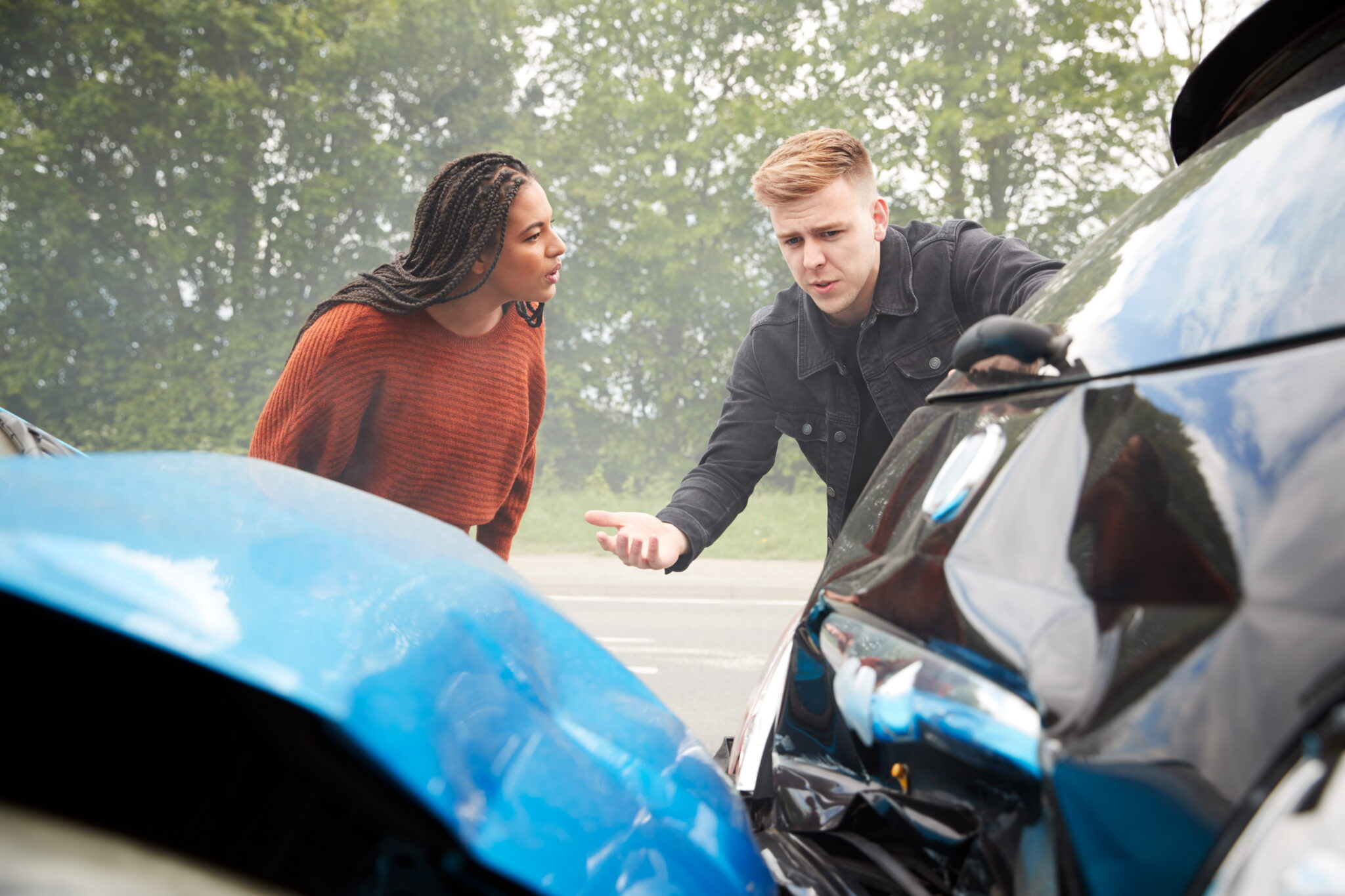
Start with the police report and your MV-104
If police responded, the officer's crash report records each driver's statement, a diagram, and often the officer's notes on apparent contributing factors. Insurers read it first, but it is not final and it is not always right. Officers usually arrive after the collision and rely on what the drivers say. If the report contains an error, you can ask the reporting agency how to submit a correction or a supplemental statement. If the reporting agency does not agree to “amend” the report, that is not necessarily a problem because much of the information on a police accident report is not admissible at trial.
Vehicle damage and accident reconstruction
Sheet metal does not change its testimony. The location, depth, and direction of damage often contradicts a false account on its own. A crushed rear bumper undercuts a driver who claims you backed into them. Paint transfer along a rear quarter panel tells a different sideswipe than the one described in their statement. In seriously disputed cases, an accident reconstruction expert can combine crush measurements, skid marks, debris fields, and final rest positions into an opinion about speed and angle of impact that a jury can weigh against each driver's story.
Most vehicles on the road also carry an event data recorder, often called a black box. It captures data such as speed, throttle, braking, and seat belt use in the seconds before a collision. A download can show that the other driver never braked or was traveling well above the limit. The data is only useful if someone acts before the vehicle is repaired, sold, or scrapped, which is one more reason to involve counsel quickly in a disputed fault case.
Find the cameras before the footage is gone
Intersections, buses, businesses, apartment buildings, and front doors are covered by more cameras than most drivers realize. Traffic cameras, store security systems, doorbell cameras, and dash cams regularly capture crashes or the moments before them. The problem is retention. Many systems overwrite their storage within days. An attorney can identify likely cameras, request the footage, and send preservation letters that put the owner on written notice to save it. A preservation letter also creates consequences if the footage later disappears, because courts can penalize a party that destroys evidence after notice.
What the evidence shows
| Evidence | What it can prove | How fast it disappears |
| Vehicle damage patterns | Direction, angle, and force of the impact | Repairs or salvage can erase it within weeks |
| Event data recorder | Speed, braking, and throttle in the seconds before impact | Lost when the vehicle is repaired, sold, or scrapped |
| Camera footage | The crash as it actually happened | Many systems overwrite within days |
| Witness statements | An independent account with no stake in the outcome | Memories fade and witnesses become hard to locate |
| Medical records | When you were hurt and how the injuries connect to the crash | Gaps in treatment weaken the connection over time |
Witnesses, medical records, and social media
An independent witness is powerful for a simple reason. They have nothing to gain. A passenger's account can be discounted as loyal, but a pedestrian or another motorist who saw the light change carries real weight with adjusters and juries. Names and phone numbers gathered at the scene are ideal, and canvassing nearby businesses can locate witnesses later. The firm has written about how witness testimony affects accident cases and the difference a credible third party account makes in a disputed claim.
Your medical records do quiet work in the background. Prompt treatment and consistent follow up tie your injuries to the crash and leave little room for the argument that you were hurt somewhere else.
How insurers investigate conflicting accounts
When the two drivers' statements conflict, the insurers do not simply pick a side. Adjusters compare each account against the police report, the MV-104 filings, photographs, repair estimates, and any footage. Some claims go to special investigation units. If a lawsuit is filed, both drivers eventually testify under oath at depositions, where a fabricated story tends to collapse under detailed questioning because the physical evidence has already fixed the facts. The firm's guide to what happens after a deposition in a car accident case explains how that testimony shapes settlement talks.
Why disputed fault cases need a lawyer early
Every category of proof described above, in some sense, decays. Vehicles get repaired, footage gets overwritten, witnesses move, and recollections blur. The first weeks after the crash are when preservation letters, camera canvasses, event data downloads, and reconstruction inspections either happen or become impossible. An attorney can also handle the other driver's insurer directly, so nothing you say gets reshaped to fit their version. The car accident attorneys at William Mattar, P.C. investigate disputed fault crashes across New York State, and an early free case review costs nothing. No lawyer can promise a result, but acting early keeps the proof available for the fight over fault percentages that CPLR 1411 makes so important, especially after a recent change in the law where New York’s pure comparative fault regime was “modified.” An experienced attorney can explain the consequences of this change in the law.
Frequently asked questions
How do you prove the other driver is lying about a car accident?
Match their statement against evidence that does not change, meaning vehicle damage patterns, event data recorder downloads, camera footage, independent witness accounts, and the timing of medical treatment. When a story contradicts the physical evidence, adjusters and juries believe the evidence.
Can a police report be changed after a New York car accident?
The reporting agency controls its own report, but you can ask about submitting a correction or a supplemental statement, and your attorney can provide supporting evidence. You can also file your own MV-104 driver report with the DMV, which puts your signed account of the crash in an official file.
What is a car's black box and can it be used after an accident?
Most modern vehicles carry an event data recorder that stores speed, braking, throttle, and seat belt data from the seconds before a collision. That data can be downloaded and used to test each driver's account, but it must be preserved before the vehicle is repaired, sold, or scrapped.
What happens if the other driver is not truthful to their insurance company?
The insurer investigates conflicting accounts against the police report, MV-104 filings, photographs, and footage, and a story that contradicts the evidence.
Can I still recover if the insurance company says I was partly at fault?
Yes. Under CPLR 1411, being partly at fault does not bar your claim. Your recovery is reduced by your percentage of fault, which is exactly why it is worth fighting a false account that can potentially inflate that percentage.
Is the other driver telling a different story about your New York crash? The attorneys at William Mattar, P.C. are available 24/7 with no fee unless your case recovers money. Call (844) 444-4444. Offices and intake locations across New York State.
About William Mattar, P.C.
William Mattar, P.C. is a New York law firm that handles motor vehicle accident cases and has represented injured people for over 30 years. The firm’s principal office is in Williamsville, with offices and intake locations across New York State. It represents motorcycle, car, truck, bus, pedestrian, and rideshare accident victims throughout New York State, with free case reviews available 24/7 at (844) 444-4444.
Related reading from William Mattar
- How Proving Distraction Helps You Meet New York’s Serious Injury Threshold
- What Happens in a Car Accident Lawsuit
- What Legally Qualifies as Distracted Driving in New York
- The Three-Year Clock. A Guide to New York's Car Accident Statute of Limitations
Each of the above is part of William Mattar’s New York State accident resource library.
Sources
- New York Vehicle and Traffic Law 605, Report required upon accident, via nysenate.gov Open Legislation
- New York Civil Practice Law and Rules 1411, via nysenate.gov Open Legislation
- New York State DMV, Report of Motor Vehicle Crash, form MV-104, dmv.ny.gov
- William Mattar, P.C., car accident practice and blog pages, williammattar.com, reviewed July 2026
Attorney Advertising. This article provides general information about New York law and is not legal advice for any specific situation. Prior results do not guarantee a similar outcome. Last updated July 2026.