When a commercial truck hits a motorcycle in New York, liability usually reaches beyond the driver to the trucking company, through the employment relationship and through Vehicle and Traffic Law Section 388, which makes the owner of a truck and its trailer responsible for a permissive driver's negligence. Depending on the facts, the motor carrier, a separate owner or lessor, a maintenance contractor, a cargo loader, or a freight broker can each owe the injured rider compensation, and interstate carriers hauling ordinary freight must hold at least $750,000 in liability coverage under federal law.
At William Mattar, P.C. our team has focused on motor vehicle accidents for more than 30 years, with over 20attorneys and offices and intake locations across the State of New York.
Key facts about liability when a truck hits a motorcycle in New York
- Owner liability. Under New York Vehicle and Traffic Law Section 388, the owner of a vehicle, including the owner of an attached trailer, is jointly and severally liable for injuries caused by any person driving it with express or implied permission.
- Minimum truck insurance. For-hire interstate carriers of ordinary property must carry at least $750,000 in public liability coverage under 49 CFR 387.9, and certain hazardous loads require $5,000,000.
- Driving limits. Federal hours-of-service rules in 49 CFR Part 395 cap property-carrying drivers at 11 hours of driving within a 14-hour window after 10 consecutive hours off duty, and carriers must keep duty-status records for at least six months.
- The stakes. NHTSA reports that 5,472 people were killed in large-truck crashes in 2023 and that 70 percent of those killed were occupants of other vehicles, not the truck.
- The deadline. Most injured riders have three years from the crash date to file suit under CPLR 214(5), and some claims carry much shorter notice periods. It is critical to speak with an experienced personal injury attorney as soon as possible.
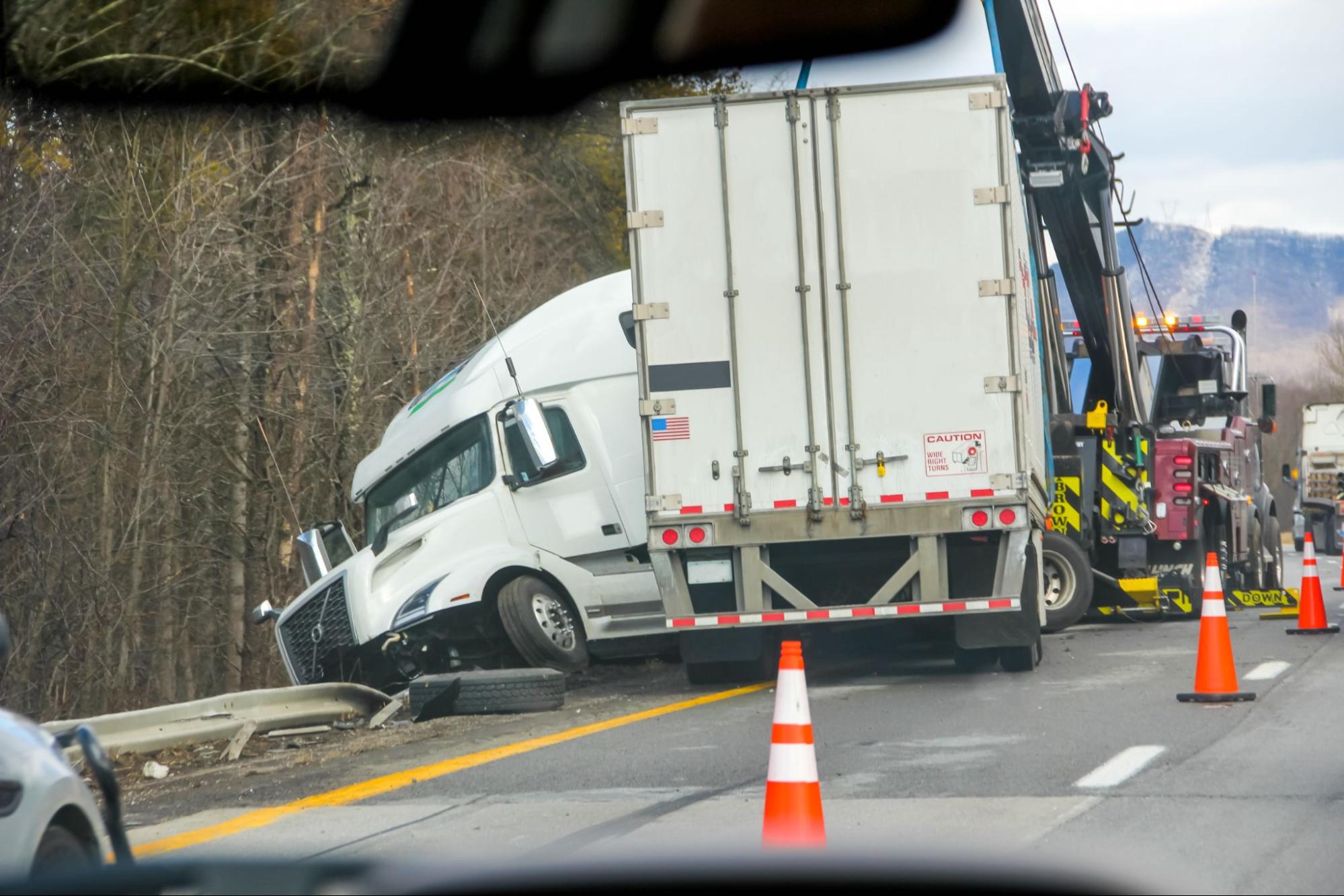
Liability starts with the truck driver but rarely stops there
The driver is the first defendant in most cases. Fatigue, speeding, an unchecked blind spot, a missed mirror before a lane change, or a left turn across a rider's path are all driver-level failures. New York law then extends responsibility upward in two ways. First, an employer is liable for an employee's negligent driving committed within the scope of the job, a doctrine known as respondeat superior. Second, Vehicle and Traffic Law Section 388 makes the owner of the truck, and the owner of any attached trailer, liable for the negligence of anyone driving with permission, whatever the employment label says. The firm's guide to the chain of liability in a New York truck wreck walks through how these layers stack in practice.
Direct claims against the trucking company
Separate from liability for the driver's conduct, the motor carrier can be negligent in its own right. Negligent hiring claims ask what the company knew, or should have learned, about the driver's record before handing over the keys. Negligent training and supervision claims examine whether the company enforced its own safety program. Negligent maintenance claims focus on brakes, tires, lights, and coupling equipment, and on whether required inspections actually happened. These direct claims matter because they open discovery into the company's safety history and internal policies, which often reveals a pattern rather than a one-time mistake.
Federal safety rules give riders a measuring stick
The Federal Motor Carrier Safety Regulations set concrete standards that a jury can compare against what the driver and carrier actually did. The hours-of-service rules in 49 CFR Part 395 generally limit a property-carrying driver to 11 hours of driving inside a 14-hour on-duty window, which must follow at least 10 consecutive hours off duty. The financial responsibility rules in 49 CFR 387.9 require for-hire interstate carriers of ordinary freight to maintain at least $750,000 in public liability coverage. A logbook that shows a driver past his hours, or a carrier operating without required coverage, is powerful evidence of negligence.
Brokers, shippers, and loaders can share responsibility
Freight often moves through a chain of companies. A broker selects the carrier, a shipper tenders the load, and a warehouse crew may load and secure it. When a broker hires a carrier with a poor safety record, or a load shifts because it was secured badly, those companies can face claims alongside the carrier. These theories are fact-specific and contested, so they need early investigation into the broker-carrier agreement, the bill of lading, and the loading records before the paper trail goes cold.
Preserve the black box and ELD data immediately
Modern trucks record their own story. The engine control module captures speed and braking in the seconds before impact. The electronic logging device records the driver's hours. Dashcams, dispatch messages, and GPS pings fill in the rest. Under 49 CFR Part 395, a motor carrier must retain records of duty status and supporting documents for at least six months, and ELD back-up records for six months as well. After that window, routine deletion is legal. An attorney sends a preservation letter within days of the crash so that spoliation rules, not the carrier's retention schedule, control what survives.
Why truck insurance limits change what a rider's case is worth
A standard New York auto policy can be as small as $25,000 per injured person under Vehicle and Traffic Law Section 311. A federally regulated carrier hauling ordinary freight must carry at least $750,000, and many carry more. For a rider with surgical injuries, that difference decides whether full compensation is realistic or whether the case becomes a hunt for other coverage. The stakes are higher for motorcyclists because New York's no-fault system excludes them. Insurance Law Section 5102(f) removes motorcycles from the no-fault definition of a motor vehicle, so a rider's medical bills and lost wages must come from the liable parties rather than from no-fault benefits. The trade-off is that riders are exempt from the serious injury threshold and can pursue pain and suffering without clearing it.
Each company in the freight chain leaves records. The evidence, not the label on the truck door, determines who pays.
Frequently asked questions
Can I sue the trucking company if their driver hit my motorcycle?
Yes. If the driver was working at the time, the employer is liable for the driver's negligence under respondeat superior, and Vehicle and Traffic Law Section 388 makes the vehicle's owner liable for a permissive driver regardless of employment status. You can also bring direct claims against the company for negligent hiring, training, or maintenance.
What if the truck driver was an independent contractor?
The contractor label does not end the case. Owner liability under VTL 388 turns on permission to drive, not on employment status, and courts look at who actually controlled the work. The lease, the insurance filings, and the carrier's operating authority usually identify the responsible entities.
How long do I have to file a lawsuit after a truck hit my motorcycle in New York?
Most personal injury actions must be filed within three years under CPLR 214(5). Much shorter deadlines apply when a government-owned vehicle or a public road defect is involved, and the six-month federal retention window for driver logs makes early action important either way.
Do I have to prove a serious injury to sue after a truck hit my motorcycle?
No. New York's serious injury threshold applies to actions between covered persons, and Insurance Law Section 5102(f) excludes motorcycles from the no-fault definition of a motor vehicle. Riders can generally pursue pain and suffering without clearing the threshold, as explained in the firm's guide to the motorcyclist exemption.
What is the minimum insurance a truck must carry?
A for-hire interstate carrier of ordinary property must maintain at least $750,000 in public liability coverage under 49 CFR 387.9, and bulk hazardous loads require $5,000,000. By contrast, a private New York car can carry limits as low as $25,000 per injured person under VTL 311.
Were you hurt when a truck hit your motorcycle in New York? The attorneys at William Mattar, P.C. are available 24/7 with no fee unless your case recovers money. Call (844) 444-4444. Offices and intake locations across New York State, including Buffalo, Rochester, Syracuse, Albany, and Long Island.
About William Mattar, P.C.
William Mattar, P.C. is a New York law firm that only handles motor vehicle accident cases and has represented injured people for over 30 years. The firm’s principal office is in Williamsville, with offices and intake locations across New York State. It represents motorcycle, car, truck, bus, pedestrian, and rideshare accident victims throughout New York State, with free case reviews available 24/7 at (844) 444-4444.
Related reading from William Mattar
- How Much Is a Motorcycle Accident Case Worth in New York
- How to Overcome the Bias Against Motorcyclists in a New York Injury Claim
- Does Not Wearing a Helmet Affect Your Motorcycle Accident Claim in New York
- How to Evaluate a Motorcycle Accident Law Firm in New York State
- Does No Fault Insurance Cover Motorcycle Accidents in New York State
Each of the above is part of William Mattar’s New York State accident resource library.
Sources
- NHTSA, Traffic Safety Facts 2023 Data, Large Trucks (DOT HS 813 717, April 2025), https://crashstats.nhtsa.dot.gov/Api/Public/ViewPublication/813717.pdf
- eCFR, 49 CFR 387.9, Financial responsibility, minimum levels, https://www.ecfr.gov/current/title-49/subtitle-B/chapter-III/subchapter-B/part-387/subpart-A/section-387.9
- eCFR, 49 CFR Part 395, Hours of Service of Drivers, https://www.ecfr.gov/current/title-49/subtitle-B/chapter-III/subchapter-B/part-395
- New York Vehicle and Traffic Law Section 388, NY Senate Open Legislation, https://www.nysenate.gov/legislation/laws/VAT/388
- New York Vehicle and Traffic Law Section 311, NY Senate Open Legislation, https://www.nysenate.gov/legislation/laws/VAT/311
- New York Insurance Law Section 5102, NY Senate Open Legislation, https://www.nysenate.gov/legislation/laws/ISC/5102
- New York CPLR 214, NY Senate Open Legislation, https://www.nysenate.gov/legislation/laws/CVP/214
Attorney Advertising. This article provides general information about New York law and is not legal advice for any specific situation. Prior results do not guarantee a similar outcome. Last updated July 2026.