No insurer pays them automatically. Because New York’s no-fault law excludes motorcyclists under Insurance Law Article 51, there is no Personal Injury Protection paying your hospital bills in the background the way there would be after a car crash. Your bills are ultimately recovered from the at-fault driver through a liability claim, but that money arrives at the end of the case, while the bills arrive immediately.
Key facts for injured riders
- New York’s no-fault system does not cover motorcyclists, so no insurer pays medical bills automatically after a crash.
- Health insurance is the bridge that keeps treatment funded while the liability claim is pending. Using it is almost always the right move.
- Insurers and hospitals that pay or provide treatment typically acquire repayment rights, called liens, against the eventual settlement. Lien amounts are frequently negotiable, and reducing them is real money.
- Early settlement offers are usually calculated from bills to date and ignore future treatment. Releases are final.
A specific order of sources fills the payment gap. Managing that order well protects both your treatment and your eventual settlement.

With no automatic payer after a motorcycle crash, bills accumulate while the liability claim is pending, which is exactly the leverage insurers use.
The actual order of payment
| Order | Source | What it covers | The catch |
|---|---|---|---|
| 1 | Your health insurance | Treatment as it happens | Asserts a lien or subrogation right, repaid from your settlement |
| 2 | Medical payments coverage on your motorcycle policy, if purchased | Bills up to its limit, regardless of fault | Most riders never purchased it |
| 3 | Medicaid or Medicare, where applicable | Treatment as it happens | Statutory repayment rights with formal resolution processes |
| 4 | The at-fault driver’s liability insurer | Everything, at the end | Pays only at settlement or judgment |
| 5 | Your uninsured or underinsured motorist (SUM) coverage | When the driver carries no or minimal insurance | Strict policy notice deadlines |
Two practical habits follow from this table. First, use your health insurance from day one. Paying out of pocket does not strengthen a claim; it creates debt, and treating without coverage creates the treatment gaps insurers later point to. Second, make sure every provider bills the correct source. Hospital billing departments are set up for car accident claims and will sometimes bill a no-fault carrier that owes nothing on a motorcycle claim, leaving bills unpaid and credit damaged while the error is corrected. Tell every provider clearly that this was a motorcycle crash, that no-fault does not apply, and which health plan to bill.
How liens reduce a motorcycle accident settlement
When your health insurer pays crash-related treatment, it usually acquires a right to be repaid from your recovery, through plan subrogation terms or, for employer self-funded plans, federal ERISA rights. Hospitals can assert their own liens against personal injury recoveries under New York’s hospital lien statute, Medicaid and Medicare hold statutory repayment rights with their own resolution procedures.
The settlement number is not the take-home number, and the negotiation does not end when the insurance company agrees to pay. Lien amounts are frequently negotiable, particularly hospital liens billed at full charge rates and plan claims that include unrelated treatment. A lien reduced by several thousand dollars returns that money directly to the rider without changing the settlement, which is why lien resolution is part of the case rather than an afterthought.
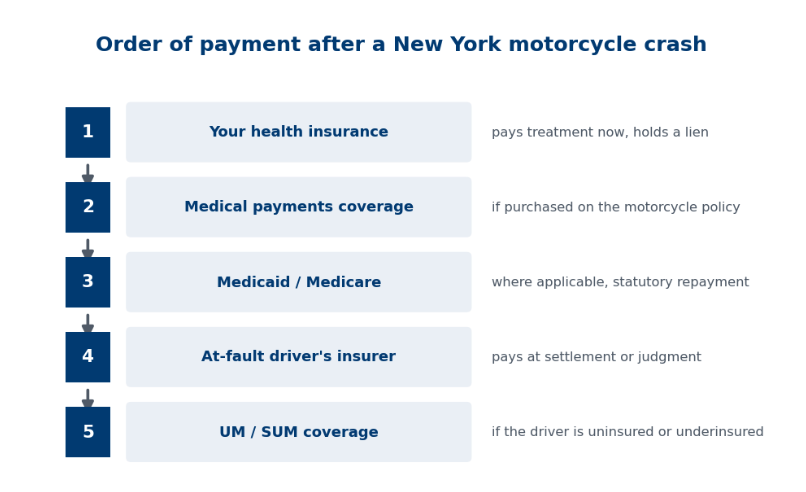
Order of payment sources for medical bills after a New York motorcycle crash, from health insurance through to the at-fault driver’s liability insurer
How riders recover lost wages
There is no automatic wage replacement for riders. A car occupant’s no-fault coverage pays 80 percent of lost earnings, up to $2,000 a month, under Insurance Law § 5102(a). A rider recovers nothing until the liability claim resolves, which makes documentation essential: pay stubs, an employer letter confirming missed time and rate, tax returns and invoices for the self-employed, and medical records connecting the missed work to the injuries. Riders who assemble this documentation from the first week may recover more than riders who reconstruct it months later, because undocumented wage loss is treated as no wage loss.
How timing pressure leads to low settlements
Insurers understand the financial pressure this structure creates. Accumulating bills with no automatic payer are the leverage behind early settlement offers, which are typically calculated from bills to date and ignore future treatment entirely. Once a release is signed, it is final. If hardware removal surgery, injections, or another round of physical therapy comes a year later, it is paid out of pocket. Two rules protect riders: do not value the claim until the medical picture is stable, and do not sign a release until future care is priced in.
Frequently asked questions
Should I use my health insurance for motorcycle accident bills in New York?
Yes, in most cases, immediately (though every case is unique). It keeps treatment going, protects your credit, and the repayment right it creates is usually negotiable later. The alternative is to pay out of pocket for unpaid bills and collections while your claim is pending.
Can the hospital bill me directly instead of my insurance?
Hospitals sometimes attempt this after crashes, preferring a lien against the settlement at full charge rates under Lien Law § 189 over insurer-discounted rates. You can insist that treatment be billed to your health insurance.
Does no-fault pay anything at all for a motorcycle crash in New York?
Not for the rider or passenger. Motorcycles are excluded from the no-fault system under Insurance Law Article 51. A pedestrian struck by a motorcycle is treated differently, but the rider’s own bills are never paid by no-fault.
The at-fault driver’s insurer offered to start paying my bills. Should I accept?
Be careful. Insurers rarely pay piecemeal without conditions, and early arrangements are often paired with recorded statements or releases that limit the full claim. Have any such offer reviewed first.
What happens to my medical bills if my claim does not succeed?
Health insurance payments generally stand, because the repayment right only attaches to a recovery. That is one reason contingency representation carries less financial risk for riders than people assume.
Who pays if the driver who hit me had no insurance?
Your own uninsured motorist coverage, and SUM coverage if you purchased it. Both carry notice requirements that can be short, so the policy should be reviewed within weeks of the crash.
The motorcycle accident attorneys at William Mattar can help after a motorcycle crash. Free case reviews 24/7 at (844) 444-4444 . Offices in Williamsville, Buffalo, Rochester, Syracuse, Albany, and on Long Island, serving riders across New York State, including New York City.
About William Mattar Accident Lawyers
William Mattar is a New York law firm that handles motor vehicle accident cases and has represented injured people for over 30 years, with its principal office in Williamsville and offices and intake locations in Buffalo, Rochester, Syracuse, Albany, and on Long Island. The firm represents motorcycle, car, truck, bus, pedestrian, and rideshare accident victims throughout New York State under its No Fee Until We Win℠ promise, with free case reviews available 24/7 at (844) 444-4444.
Sources
- New York Insurance Law Article 51, including § 5102(a)
- New York Lien Law § 189 (hospital liens)
- New York Civil Practice Law and Rules § 214
- Federal Medicare Secondary Payer provisions and New York Medicaid recovery rules (statutory repayment rights)
- New York State Department of Financial Services, SUM coverage regulations
Attorney Advertising. This article provides general information about New York law and is not legal advice for any specific situation. Prior results do not guarantee a similar outcome. Last updated June 2026.