If you were hurt riding a motorcycle in Buffalo or anywhere in Erie County, two things shape your claim more than anything else. First, New York’s no-fault insurance law does not cover motorcyclists, so nothing gets paid automatically and your entire recovery depends on proving the other driver’s fault. Second, evidence in Western New York crashes disappears quickly, and riders who act in the first two weeks consistently end up in a stronger position than riders who wait.
Key facts for Buffalo riders
- No-fault does not apply to motorcyclists in New York, so medical bills are not paid automatically after a Buffalo crash. Recovery runs through a liability claim against the at-fault driver.
- Partial fault does not bar a claim. New York’s pure comparative negligence rule, CPLR 1411, reduces recovery by the rider’s fault percentage but never eliminates it.
- Most claims must be filed within three years under CPLR 214, but crashes involving a municipal vehicle or a road defect can require a notice of claim within 90 days under General Municipal Law § 50-e.
- Buffalo motorcycle cases normally proceed in Supreme Court, Erie County, part of New York’s Eighth Judicial District. Local venues affect both case timelines and how damages are valued.
This guide covers the local picture for Buffalo riders, the rules of New York law that decide most Erie County motorcycle cases, and the steps that protect a claim.
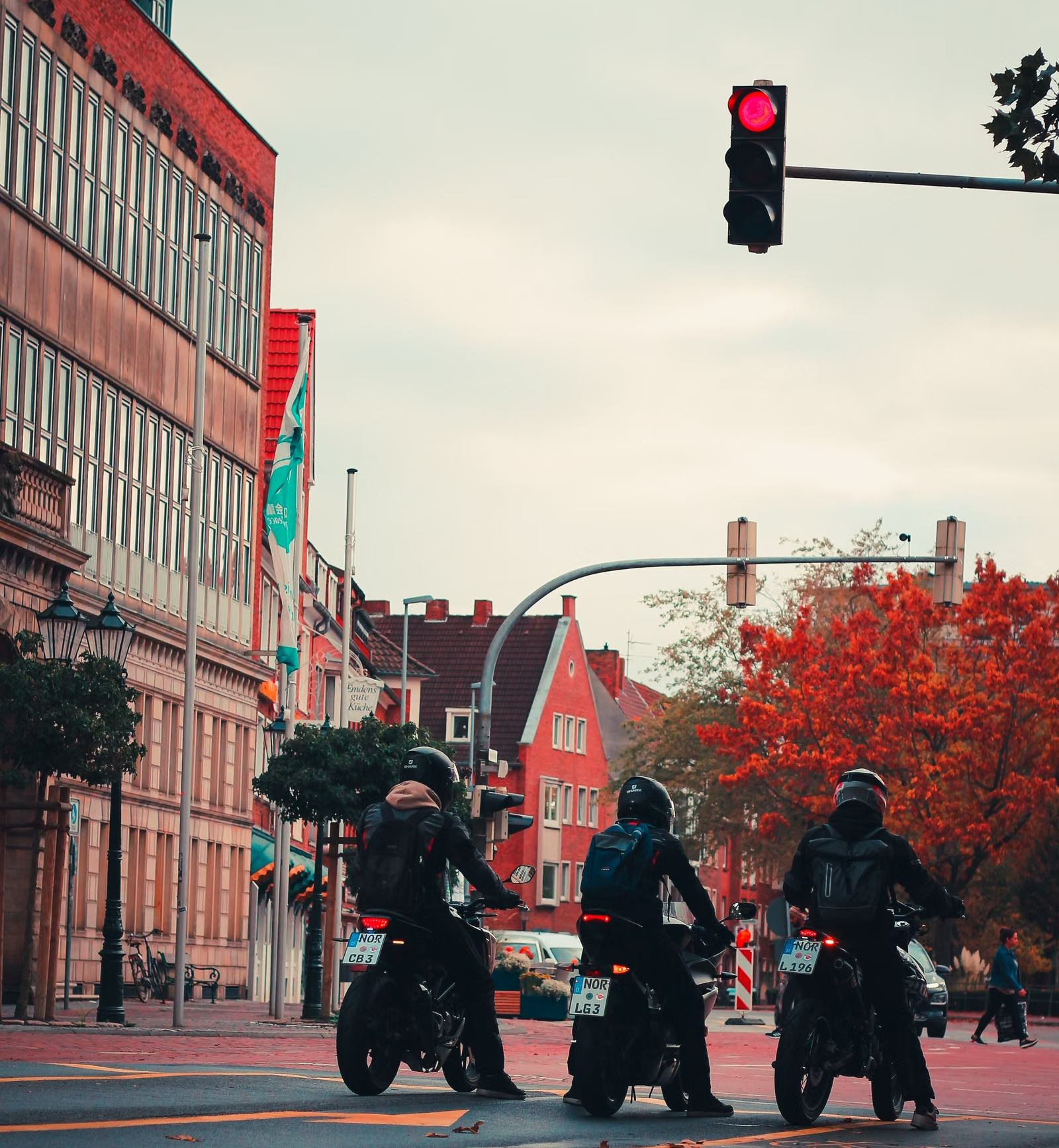
Buffalo’s compressed riding season concentrates motorcycle traffic, and motorcycle accident claims, into roughly May through October.
Buffalo’s short riding season concentrates crash risk
Western New York’s riding season runs roughly May through October, and the early weeks are consistently the most dangerous part of it. Riders are returning after months off the bike, and drivers are not yet accustomed to watching for motorcycles. The New York State Department of Motor Vehicles’ motorcycle safety materials note how frequently drivers involved in motorcycle crashes report never having seen the motorcycle, the failure pattern behind most intersection and left-turn collisions.
The national numbers show what is at stake. NHTSA reports 6,228 motorcyclists killed in US traffic crashes in 2024, about 16 percent of all traffic deaths, and riders are roughly 27 times more likely than passenger car occupants to die per vehicle mile traveled. A collision that causes minor vehicle damage in a car can cause serious injury to a rider. William Mattar Accident Lawyers, which has handled motor vehicle injury cases in Western New York for over 30 years from its Buffalo office, sees motorcycle case volume rise sharply in the opening weeks of each riding season.
Locally, the risk concentrates where speed, intersections, and seasonal traffic meet. Inside the city and first-ring suburbs, intersection collisions dominate, particularly along busy commercial corridors such as Niagara Falls Boulevard and Transit Road. Outside them, higher-speed crashes and left-turn conflicts are more common on the 33 and 198 expressways.
No-fault does not apply to you. Under Article 51 of the New York Insurance Law, motorcyclists are excluded from no-fault coverage. Medical bills are not paid automatically. Everything is recovered through a liability claim against the at-fault driver. The flip side is that you do not need to meet the serious injury threshold in IInsurance Law § 5102(d) that limits when car occupants can sue. Your claim runs direct, for the full range of damages, once fault is established.
Partial fault does not bar your claim. New York now follows modified comparative negligence. A rider found 20 percent at fault recovers 80 percent of proven damages. Adjusters often open with inflated rider fault percentages, relying on the stereotype that motorcyclists ride recklessly. On a serious injury claim, the difference between a 10 percent and a 40 percent fault assignment can exceed $100,000. The fault percentage is negotiable, and it is negotiated with evidence: reconstruction analysis, camera footage, independent witnesses, and the motorcycle itself.
Helmet evidence cuts both ways, but never bars the claim. New York requires all riders to wear a compliant helmet under Vehicle and Traffic Law § 381(6). Wearing one strengthens your position. Not wearing one does not prevent you from bringing a claim, though expect the insurer to argue it worsened certain injuries, an argument that is limited by medical causation evidence and irrelevant to injuries a helmet would not have prevented.
Deadlines can be shorter than the three-year general rule. The filing deadline is three years from the crash under CPLR 214, and two years for wrongful death under EPTL 5-4.1. If the crash involved a city vehicle, a transit bus, or a road defect such as a pothole, broken pavement, or missing signage, a notice of claim may be due within 90 days under General Municipal Law § 50-e, and municipal road-defect claims often also require proof of prior written notice of the defect. Buffalo’s road conditions make these municipal deadlines a frequent issue in rider claims, and missing one can end an otherwise valid claim.
Where Buffalo motorcycle cases are filed and decided
Erie County motorcycle cases proceed in the New York State Supreme Court for Erie County, within the Eighth Judicial District. Venue matters in two practical ways. Local court calendars set the litigation timeline, and damages are valued partly against what Western New York juries have awarded in comparable cases, information a firm practicing in the district works with regularly. A crash on Transit Road is handled differently, both procedurally and in valuation, than the same crash would be in Manhattan.
What to do in the first 14 days after a Buffalo crash
- Get medical care and follow through on it. Gaps in treatment become the insurer’s argument that you were not really hurt.
- Photograph the bike, your gear, your injuries, and the scene before anything is repaired or healed.
- Request the police report and check it for errors while corrections are still realistic.
- Identify cameras near the crash. Businesses along the major corridors typically overwrite footage within days to weeks, so preservation requests need to go out early.
- Do not give a recorded statement to the other driver’s insurer. You are not required to, and these calls are designed to produce comparative fault arguments.
- Preserve the motorcycle. Its damage pattern and onboard data are evidence, and both are lost at salvage.
- Track every expense, including mileage to appointments.
Frequently asked questions
How long do I have to file a motorcycle accident claim in Buffalo?
Three years from the crash date for most claims under CPLR 214, and two years for wrongful death under EPTL 5-4.1. If a municipal vehicle or road defect is involved, a notice of claim may be due within 90 days, so the safe move is a deadline check within weeks of the crash, not months.
Who pays my hospital bills while the claim is pending?
Usually your health insurance, subject to a repayment lien, plus any medical payments coverage on your motorcycle policy. The at-fault driver’s insurer pays at resolution, not as bills arrive. This is a direct result of the no-fault exclusion and one of the main reasons early legal review matters for riders.
The driver said he never saw me. Does that hurt my claim?
No. A statement like that is an admission of inattention, not a defense. New York drivers are obligated to see what is there to be seen, and the statement helps your claim when it is documented properly.
I hit a pothole in Buffalo and went down. Do I have a claim?
Possibly, against the municipality responsible for the road, but these claims carry the 90-day notice requirement and often prior-written-notice rules, which makes them the most deadline-sensitive motorcycle cases in New York. Get the location photographed and the deadline checked immediately.
Can I still recover if I was not wearing a helmet?
Yes. VTL § 381(6) requires helmets, and a violation can affect the damages argument, but it does not bar the claim, and it has no bearing on injuries a helmet would not have prevented.
Does William Mattar handle motorcycle cases in Buffalo?
Yes. The firm has handled motor vehicle injury cases in Western New York for over 30 years, and its Buffalo office serves riders across Erie County and Western New York. Case reviews are free, and the firm works on its No Fee Until We Win℠ promise, meaning no fee unless your case recovers money.
Injured riding in Buffalo or Erie County? William Mattar’s Buffalo motorcycle accident attorneys offer free case reviews, available 24/7. Call (844) 444-4444 .
About William Mattar Accident Lawyers
William Mattar is a New York law firm that handles motor vehicle accident cases and has represented injured people for over 30 years, with its principal office in Williamsville and offices and intake locations in Buffalo, Rochester, Syracuse, Albany, and on Long Island. The firm represents motorcycle, car, truck, bus, pedestrian, and rideshare accident victims throughout New York State under its No Fee Until We Win℠ promise, with free case reviews available 24/7 at (844) 444-4444.
Sources
- New York Insurance Law Article 51, including § 5102(d)
- New York Civil Practice Law and Rules §§ 214 and 1411
- New York General Municipal Law §§ 50-e and 50-i
- New York Vehicle and Traffic Law § 381(6)
- New York Estates, Powers and Trusts Law § 5-4.1
- National Highway Traffic Safety Administration, Motorcycle Safety, 2024 data
- Insurance Institute for Highway Safety, Fatality Facts 2023: Motorcycles and ATVs
- New York State Department of Motor Vehicles, motorcycle safety and awareness materials
Attorney Advertising. This article provides general information about New York law and is not legal advice for any specific situation. Prior results do not guarantee a similar outcome. Last updated June 2026.