Bias against motorcyclists can show up in injury claims as inflated fault percentages and low settlement offers. At William Mattar, P.C. our team has focused on motor vehicle accidents for more than 30 years, with over 20 attorneys and locations across the state.
Key facts about motorcyclist bias in New York injury claims
- The pattern holds today. In 2023, the other vehicle was turning left while the motorcycle went straight, passed, or overtook in 46 percent of fatal two-vehicle motorcycle crashes nationwide.
- New York riders wear helmets. Based on known helmet use, 81 percent of New York motorcyclists killed in 2023 were helmeted, one of the higher rates in the country under the state's universal helmet law.
- New York riders are overwhelmingly sober. State data shows 97 percent of motorcycle operators in New York fatal and injury crashes in 2023 had no alcohol involvement, nearly identical to the 98 percent figure for all other drivers.
- Fault percentages carry a price. Under CPLR 1411, damages are reduced in proportion to the claimant's share of fault, and a 2026 amendment can bar recovery entirely in certain personal injury actions when the claimant's fault exceeds the defendant's.
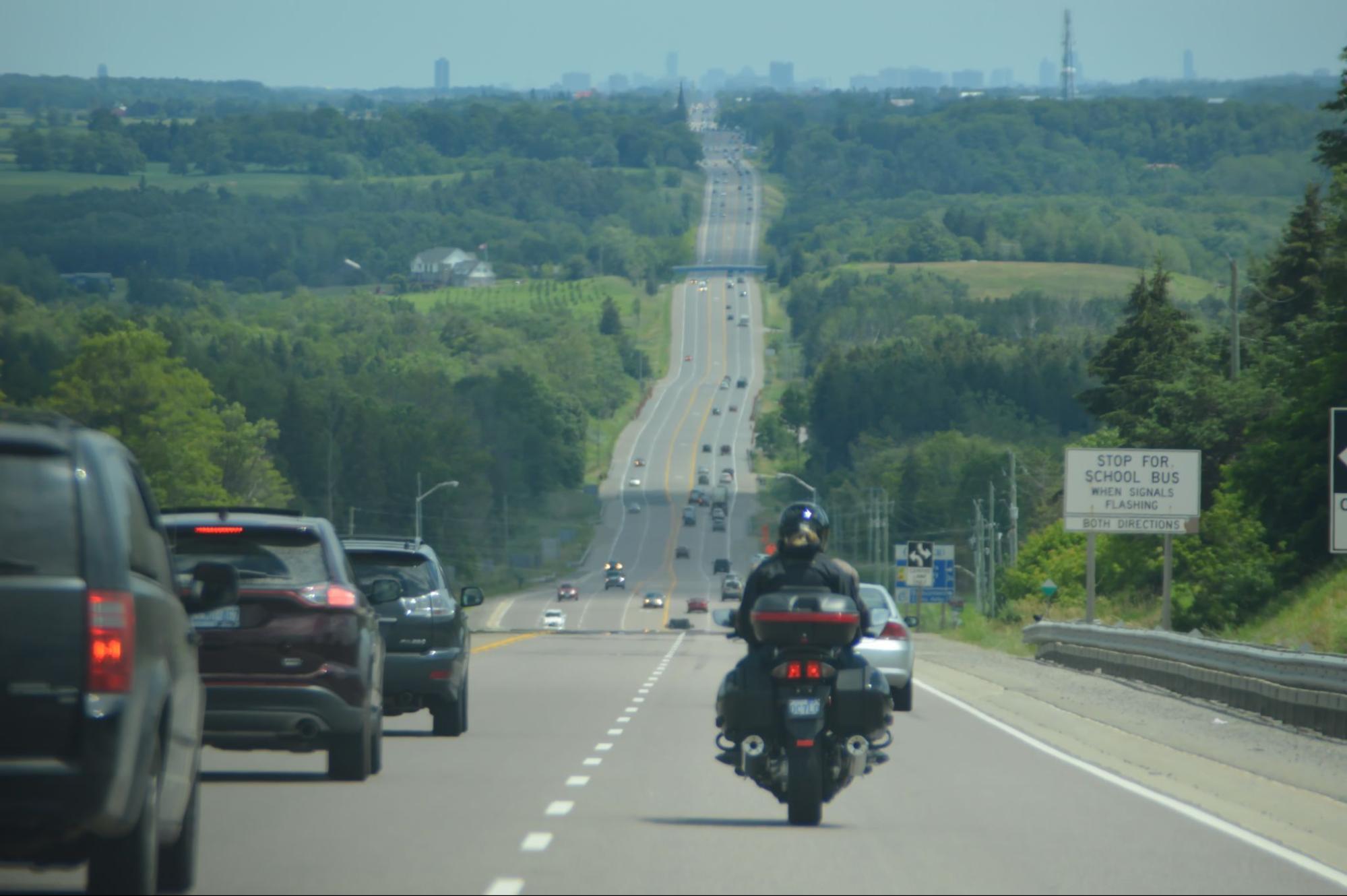
How bias might show up inside a claim
Anti-rider bias rarely announces itself. It appears as an adjuster's opening theory that you must have been speeding, a recorded statement steered toward how fast you were going, a liability decision that assigns you 30 or 40 percent of the fault on thin evidence, and a settlement offer discounted for how a jury might see a motorcyclist. Defense lawyers know that some jurors carry assumptions about riders, and some insurers try to price that risk into every offer.
The data separates riders from the stereotype
The strongest antidote to a stereotype is verified data. NHTSA's 2023 motorcycle fact sheet reports that in 46 percent of fatal two-vehicle motorcycle crashes the other vehicle was turning left while the motorcycle was going straight or overtaking. New York numbers undercut the stereotype further. Known helmet use among New York riders killed in 2023 was 81 percent. A claim built on these numbers forces the insurer to talk about this crash and this rider instead of an imagined one. What is most important is how the particular incident occurred.
Why every percentage point of fault is expensive under CPLR 1411
Comparative fault is where bias becomes money. Under CPLR 1411(a), a rider's own culpable conduct does not bar recovery, but damages are reduced in proportion to the rider's share of fault, so a $500,000 case carrying a 30 percent fault finding pays $350,000. The statute was amended effective May 2026 to add subsection (b), which bars recovery altogether in some personal injury actions involving motor vehicles when the claimant's fault is greater than the defendant's. This will be an evolving area of law that our office will monitor.
The evidence that defeats bias
Bias survives on the absence of facts, so the case is won by filling the record. Photographs of your helmet, armored jacket, gloves, and boots show a careful rider. Completion certificates from rider training courses show invested skill. Modern motorcycles and aftermarket devices capture speed and braking data, and helmet cameras or nearby doorbell, dashcam, and business cameras often capture the crash itself. Witness statements taken early, before memory fades, anchor the sequence of events. An accident reconstruction built from skid marks, crush damage, and final rest positions replaces guesswork about speed with physics. Collected quickly, this file makes the insurer's reckless-rider theory unprovable.
Frequently asked questions
Will a jury blame me because I ride a motorcycle?
Some jurors bring assumptions about riders, which is why attorneys question the panel about motorcycle attitudes during jury selection and remove those who cannot be fair. Once seated, jurors respond to specifics: What actually happened to cause the crash.
Can the insurance company reduce my settlement because I was on a motorcycle?
Not lawfully for that reason alone. Any reduction must rest on your actual share of fault under CPLR 1411.
Do I have to prove a serious injury to recover pain and suffering as a motorcyclist?
No. Because Insurance Law Section 5102(f) excludes motorcycles from the no-fault definition of a motor vehicle, riders are not subject to the serious injury threshold that applies to car occupants. The firm explains the exemption in detail in its guide to the motorcyclist threshold exemption.
What evidence should I save to fight bias after a motorcycle crash?
Keep the helmet and gear you wore, unrepaired if possible, and photograph everything. Save your training certificates, license and endorsement records, GPS or app ride data, and helmet camera files. Get names and numbers for every witness at the scene, and ask nearby homes and businesses to preserve camera footage before it is overwritten.
Is an adjuster blaming you for a crash because you ride? The attorneys at William Mattar, P.C. are available 24/7 with no fee unless you recover. Call (844) 444-4444. Offices and intake locations across New York State.
About William Mattar, P.C.
William Mattar, P.C. is a New York law firm that only handles motor vehicle accident cases and has represented injured people for over 30 years. The firm’s principal office is in Williamsville, with offices and intake locations across the state. It represents motorcycle, car, truck, bus, pedestrian, and rideshare accident victims throughout New York State, with free case reviews available 24/7 at (844) 444-4444.
Related reading from William Mattar
- Hit by an Uninsured or Underinsured Driver on a Motorcycle
- Injured as a Passenger on a Motorcycle in New York
- Who Is Liable When a Truck Hits a Motorcycle in New York
- How to Evaluate a Motorcycle Accident Law Firm in New York State
- Does No Fault Insurance Cover Motorcycle Accidents in New York State
Each of the above is part of William Mattar’s New York State accident resource library.
Sources
- Hurt, H., Ouellet, J., and Thom, D., Motorcycle Accident Cause Factors and Identification of Countermeasures, Vol. 1 (NHTSA, 1981), https://rosap.ntl.bts.gov/view/dot/6450
- NHTSA, Traffic Safety Facts 2023 Data, Motorcycles (DOT HS 813 732, July 2025), https://crashstats.nhtsa.dot.gov/Api/Public/ViewPublication/813732.pdf
- Institute for Traffic Safety Management and Research, New York State Fact Sheet, Motorcycle Crashes (December 2024), https://www.itsmr.org/wp-content/uploads/2024/12/NYS_FactSheet_Motorcycle_Crashes_Published_Dec_2024.pdf
- New York CPLR 1411, NY Senate Open Legislation, https://www.nysenate.gov/legislation/laws/CVP/1411
- New York Insurance Law Section 5102, NY Senate Open Legislation, https://www.nysenate.gov/legislation/laws/ISC/5102
Attorney Advertising. This article provides general information about New York law and is not legal advice for any specific situation. Prior results do not guarantee a similar outcome. Last updated July 2026.