Yes, it can affect the value of your claim, but it never bars the claim. Riding without a helmet violates Vehicle and Traffic Law 381(6), yet under CPLR 1411 a rider's own conduct reduces damages in proportion to fault rather than eliminating the case. The reduction applies only to injuries a helmet would have prevented or lessened, which in practice means head injuries. The insurer carries the burden of proving that connection with medical evidence, and injuries a helmet could not have stopped, such as a broken leg or road rash, are unaffected.
At William Mattar, P.C. our team has focused on motor vehicle accidents for more than 30 years, with over 20 attorneys and offices and intake locations across the state.
Key facts about helmets and New York injury claims
- Vehicle and Traffic Law 381(6) requires every motorcycle operator and passenger to wear a helmet that meets federal standards, and violations are traffic infractions.
- Under CPLR 1411 a claimant's own culpable conduct does not bar recovery, and damages are reduced in proportion to that conduct. New York has recently modified the system. An experienced attorney can explain.
- The National Highway Traffic Safety Administration estimates helmets are 37 percent effective in preventing deaths of motorcycle operators and 41 percent for passengers.
- Motorcycles are excluded from the definition of motor vehicle in Insurance Law 5102, which is why the no fault rules treat riders differently from drivers.
The ticket and the claim are two different things
Riding without a helmet in New York is a traffic infraction under Vehicle and Traffic Law 381(6), which requires a helmet meeting federal motor vehicle safety standard. The ticket is resolved in traffic court with a fine. A driver who turned left across your lane can be liable whether you were wearing a helmet or not. Fault for the crash and the effect of the missing helmet are analyzed separately, and mixing them up is exactly what insurance adjusters hope you will do. Our New York motorcycle helmet laws page covers the equipment rules in detail.
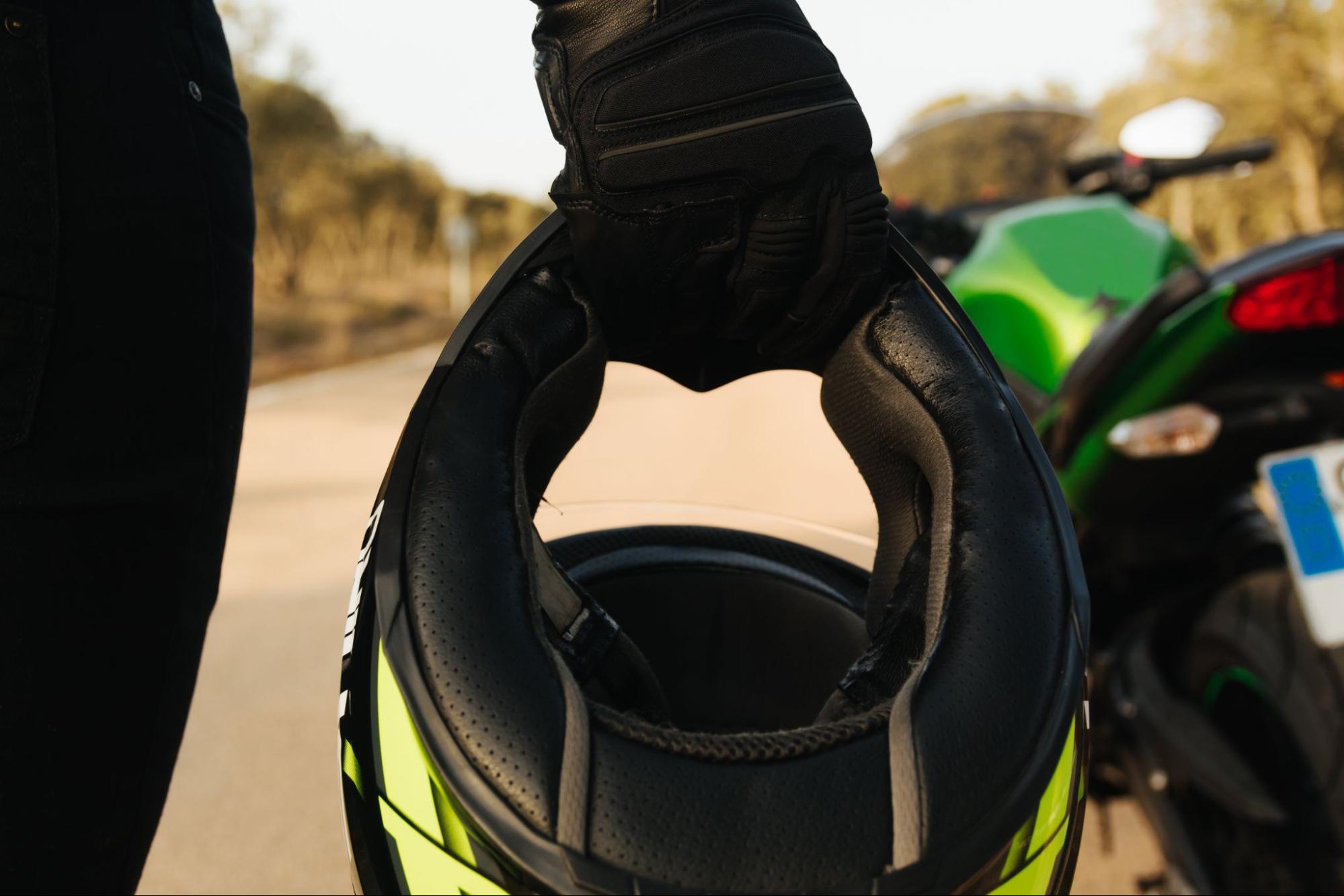
Comparative fault reduces damages, it does not erase claims
New York's general rule in CPLR 1411 states that a claimant's culpable conduct, including contributory negligence and assumption of risk, does not bar recovery. Damages are instead diminished in proportion to that conduct. New York courts treat protective equipment issues, following the seat belt line of cases, as a question of damages rather than liability. The defendant must plead the issue and prove it.
The insurer's helmet defense and its limits
Expect the insurer to raise the missing helmet early and often. The defense has real limits. First, it applies only to damages, never to whether you can bring the claim. Second, the insurer must prove causation, meaning competent medical and biomechanical evidence that a helmet would have prevented or reduced the specific injuries you suffered. That requires expert testimony about impact points, forces, and your actual diagnoses, not a general statement that helmets are safer. Third, the reduction is limited to the injuries the helmet would have affected. An adjuster who discounts your entire claim because of a helmet is overreaching, and that overreach can be challenged.
What the safety data says, and why it cuts both ways
The public health evidence on helmets is strong. NHTSA estimates helmets are 37 percent effective in preventing fatal injuries to motorcycle operators and 41 percent for passengers. NHTSA reported 6,228 motorcyclists killed in 2024, which was 16 percent of all traffic deaths. Insurers lean on these numbers to argue any bare headed rider hurt himself. The numbers also cut the other way. Population statistics do not prove what happened to your head in your crash, and courts require case specific medical proof, not averages. The data is a reason to wear a helmet, not a verdict on your claim.
What to do if you rode without a helmet
Get medical care immediately and follow through on treatment, because your records will decide how much of your injury the defense can even argue about. Do not give a recorded statement guessing about what a helmet would have changed, since that question calls for expert opinion, not yours. Photograph your injuries and keep the gear you were wearing. Then talk to a firm that handles motorcycle injury cases across New York before you discuss numbers with any adjuster, so the helmet issue is confined to its proper, narrow place in the case.
Frequently asked questions
Can I still sue if I wasn't wearing a helmet in New York?
Yes. Riding without a helmet violates Vehicle and Traffic Law 381(6), but at most it can reduce damages for injuries a helmet would have prevented, and the insurer must prove that with medical evidence.
Is it illegal to ride without a helmet in New York?
Yes. New York requires every motorcycle operator and passenger to wear a helmet that meets federal standards. A violation is a traffic infraction punishable by a fine, and it is separate from any injury claim arising out of the crash.
How much can not wearing a helmet reduce my settlement?
There is no fixed percentage. Any reduction is limited to damages for head injuries the insurer proves a helmet would have prevented or lessened, established through expert medical testimony. Claims built on broken bones, road rash, or internal injuries are not reduced at all.
Does a helmet ticket prove I was at fault for the accident?
No. The ticket addresses an equipment violation, not the cause of the collision. A driver who ran a light or turned across your lane remains liable for causing the crash regardless of what you were wearing.
Does the helmet defense apply to passengers too?
Yes. The helmet requirement in Vehicle and Traffic Law 381(6) covers passengers, and an insurer can make the same damages argument against an unhelmeted passenger. The same limits apply, so the insurer must prove the missing helmet worsened the specific head injuries.
Were you hurt in a New York motorcycle crash while riding without a helmet? The attorneys at William Mattar, P.C. are available 24/7. Call (844) 444-4444 . Offices and intake locations across New York State.
About William Mattar, P.C.
William Mattar, P.C. is a New York law firm that handles motor vehicle accident cases and has represented injured people for over 30 years. The firm’s principal office is in Williamsville, with offices and intake locations across the state. It represents motorcycle, car, truck, bus, pedestrian, and rideshare accident victims throughout New York State, with free case reviews available 24/7 at (844) 444-4444.
Related reading from William Mattar
- How to Evaluate a Motorcycle Accident Law Firm in New York State
- Does No Fault Insurance Cover Motorcycle Accidents in New York State
- How Much Is a Motorcycle Accident Case Worth in New York
- How to Overcome the Bias Against Motorcyclists in a New York Injury Claim
- The Best Motorcycle Accident Law Firms in New York
Each of the above is part of William Mattar’s New York State accident resource library.
Sources
- New York Vehicle and Traffic Law 381, motorcycle equipment and helmet requirement, nysenate.gov
- New York CPLR 1411, damages recoverable when contributory negligence is established, including the May 2026 amendment, nysenate.gov
- New York Insurance Law 5102, definitions of motor vehicle and motorcycle, nysenate.gov
- Centers for Disease Control and Prevention, MMWR, Helmet Use Among Motorcyclists Who Died in Crashes, 2008 to 2010, cdc.gov
- Community Preventive Services Task Force, Use of Motorcycle Helmets, Universal Helmet Laws, thecommunityguide.org
- National Highway Traffic Safety Administration, Motorcycle Safety, 2024 fatality data, nhtsa.gov
Attorney Advertising. This article provides general information about New York law and is not legal advice for any specific situation. Prior results do not guarantee a similar outcome. Last updated July 2026.