Under New York Vehicle and Traffic Law (VTL) and federal regulations, legal responsibility seldom stops at the driver's seat. A commercial truck is a business on wheels, which means several entities, such as the company and the corporation, may share financial responsibility for the collision.
While laws like NY VTL § 388 generally hold vehicle owners liable, federal statutes like the Graves Amendment complicate matters, making a surface-level investigation insufficient, and a New York truck accident lawyer can help identify every potentially responsible party. In some cases, identifying these additional defendants is the only path to securing the full compensation necessary to recover from life-altering injuries.
At William Mattar Accident Lawyers our practice is focused on personal injury cases involving motor vehicle accidents. We understand how to investigate the difficult web of relationships in the trucking industry. If you have questions about who is actually responsible for your specific accident, call us today for a free consultation.
Key Takeaways for New York Truck Wreck Liability
- Liability extends beyond the driver. Multiple parties in the chain of commerce, including the trucking company, cargo loaders, and maintenance shops, may be financially responsible for a collision.
- A trucking company is liable for its own negligence. This includes failures like negligent hiring of unsafe drivers or pressuring drivers to violate federal safety rules.
- Federal laws add layers of difficulty. Statutes like the Graves Amendment shield some equipment owners from liability, but exceptions for direct negligence or corporate structure make a thorough investigation essential.
The Chain of Commerce vs. the Chain of Liability
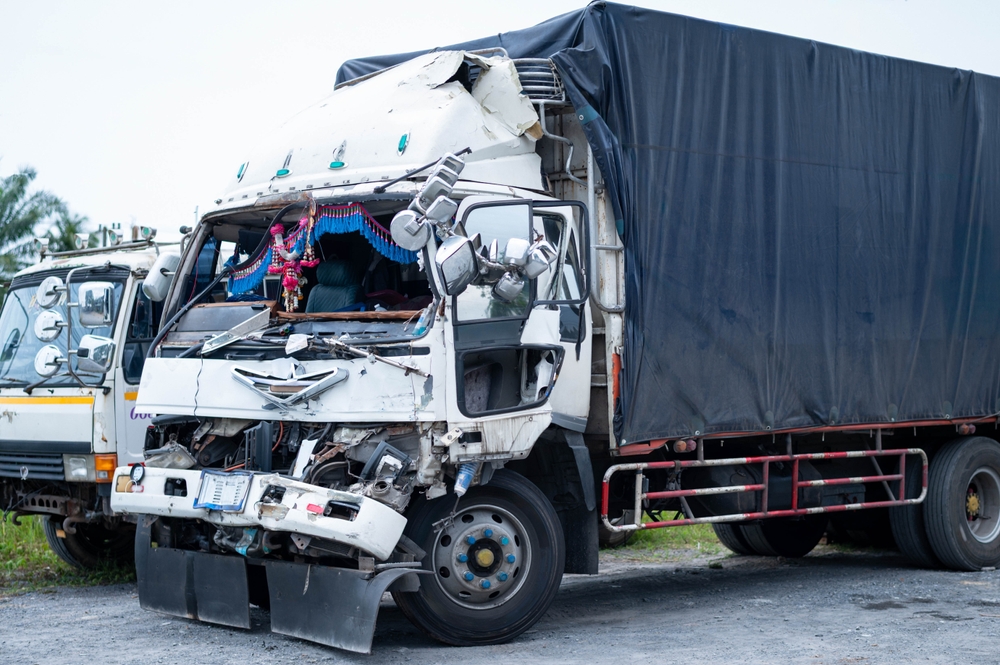
To understand liability in a truck wreck, it helps to visualize the journey of the truck and its cargo as a Chain of Commerce, and pinpointing fault in an NYC truck wreck often requires looking at every link in that chain. This chain involves numerous independent businesses, each with a specific job to do before the truck's wheels ever start turning on a New York highway.
Think about the typical lifecycle of a single shipment:
- A freight broker connects a manufacturer with a shipping solution.
- A shipper, or a third-party logistics company, packs and seals the cargo inside the trailer.
- A motor carrier (the trucking company) accepts the job and assigns it to a driver.
- A maintenance shop performs a pre-trip inspection or repair and clears the rig for service.
- Finally, the driver turns the key and begins the journey.
Every entity that touched that shipment has a duty to perform its job safely. When a crash occurs, it is a potential failure at any point upstream in that chain. An unbalanced load, a faulty brake repair, or immense pressure from a dispatcher to meet an unrealistic deadline are all failures that begin long before the moment of impact.
In cases involving catastrophic injuries, such as a traumatic brain injury or spinal cord damage, expanding the investigation to the entire Chain of Liability may be a necessary step toward securing full and fair justice.
Link 1: The Motor Carrier (The Trucking Company)
When an accident happens, a common defense from the trucking company is to claim the driver was an independent contractor. They do this to create legal distance, arguing they are not responsible for the driver's negligent actions.
If this argument succeeds, you could be left with a claim against only the driver, which is especially risky if it involves an uninsured truck driver in New York with limited coverage and personal assets. This is a common scenario, as thousands of trucks operating under an independent contractor model travel on New York roads every day.
Vicarious Liability and the Illusion of Independence
The legal doctrine of respondeat superior, or vicarious liability, holds an employer responsible for the wrongful acts of an employee. This likely applies even in cases where, on paper, the truck driver is a contractor.
In New York, courts will look beyond the contractor label on a driver's employment agreement. If the trucking company exerted significant control over the driver (dictating their routes, controlling their schedule, requiring them to use company equipment, or imposing work rules), a court may find that an employer-employee relationship existed in practice, making the company liable.
Direct Negligence: When the Company Itself Fails
In some cases, in addition to its responsibility for the driver's actions, the trucking company is also directly negligent. This falls into two categories:
- Negligent Hiring and Retention: The Federal Motor Carrier Safety Administration (FMCSA) requires trucking companies to thoroughly investigate a driver’s background and safety history before hiring them. If a company hires a driver with a documented history of DUIs, license suspensions, or reckless driving and that driver causes an accident, the company could be held directly liable for putting a dangerous driver on the road.
- Forced Negligence and Hours of Service: Federal Hours of Service (HOS) regulations exist to prevent fatigued driving. These rules strictly limit the number of hours a driver is on the road. If a motor carrier pressures a driver to violate HOS rules, falsify their logbook, or speed to meet an impossible delivery deadline, the company is actively participating in the negligence that leads to a crash.
Link 2: The Cargo Ecosystem (Shippers, Loaders, and Brokers)
The companies responsible for what’s inside the trailer play a significant role in the truck's overall safety. From improperly secured loads to hazardous materials, the cargo itself is sometimes the primary cause of a wreck, and the liability extends far beyond the motor carrier.
The Shipper & Loader: The Hands-Off Myth
A surprising number of truck accidents are by cargo that shifts, falls, or unbalances the trailer, leading to a rollover or jackknife. Federal laws clearly outline requirements about cargo being properly distributed and secured, as well as standards for blocking, bracing, and tying down different types of cargo.
In many cases, the trailer is loaded and sealed by a third-party logistics (3PL) company before the driver ever arrives. The driver may be legally unable to break the seal to inspect the load. In a fatal truck accident, improperly secured cargo that shifts mid-journey and causes the driver to lose control can make the company that loaded the trailer potentially liable for the resulting crash.
The Freight Broker: The Middleman Defense
Freight brokers act as intermediaries, connecting shippers with motor carriers to transport goods. Their primary defense in an accident lawsuit is to claim they are merely travel agents for freight and hold no responsibility for the carrier's safety performance. They may argue that they just make the introduction and have no control over the driver or the equipment.
However, this defense is being challenged more frequently. The legal concept of negligent selection argues that if a broker hires a carrier with a notoriously poor safety rating (which is publicly available information from the FMCSA), the broker may be liable for choosing to partner with an unsafe company. This is a difficult and evolving area of truck accident law, and success depends on a legal team's ability to demonstrate that the broker knew, or should have known, about the carrier's dangerous history.
Link 3: The Equipment Owner & The Graves Amendment
In the modern trucking industry, it is very common for the tractor (the cab) and the trailer to be owned by two different companies. Furthermore, either or both of these components might be leased from a massive, multi-state equipment holding company. This complicated ownership structure can be a significant hurdle in a personal injury claim.
A federal law, the Graves Amendment (49 U.S.C. § 30106), generally shields companies that are in the business of renting or leasing vehicles from being held vicariously liable for the actions of the person who rented their equipment. This law was passed to protect rental car companies from lawsuits, but it also applies to truck leasing companies and blocks access to a substantial source of insurance coverage.
Piercing the Shield: Exceptions to the Rule
Fortunately, this federal shield is not absolute. An experienced legal team knows how to investigate for exceptions.
- The Negligence Exception: The Graves Amendment does not protect a leasing company from its own negligence. If the company failed to properly maintain its vehicle, for instance, by leasing out a truck with known brake defects or dangerously worn tires, it is held directly liable for any resulting accident.
- The Affiliate Exception in New York: A key case from the Western District of New York, Stratton v. Wallace, established another strategy. This case helped establish that if the leasing company and the trucking company are affiliates (for example, two separate LLCs owned by the same parent corporation), the federal shield could potentially be pierced. This allows an injured party to argue that the companies are not truly separate and that the owner liability principles of NY VTL § 388 should apply. An experienced attorney will be familiar with this case and can explain whether it may have an effect on your case.
Link 4: Maintenance Shops and Component Manufacturers
Third-Party Maintenance Failures
Federal regulations mandate that commercial vehicles undergo systematic inspection, repair, and maintenance. Many trucking companies outsource this work to third-party repair shops. Understanding what you can sue for in a truck accident matters here because if a mechanic performs a faulty repair, uses the wrong parts, or pencil-whips an inspection (signing off that the truck is safe without properly checking it), that shop is held liable for a subsequent mechanical failure that causes a crash.
Product Liability: When the Truck Itself is the Problem
In some accidents, the evidence points to a specific part that failed under normal operating conditions. This could be a tire that delaminates on the highway, a brake actuator that seizes, or a steering coupling that fractures. In these situations, a claim may be brought against the part manufacturer.
New York follows a standard of Strict Products Liability. This is a powerful tool for those injured by defective products. It means you do not necessarily have to prove the manufacturer was negligent in its design or manufacturing process. Instead, you primarily need to demonstrate that the product was defective when it left the manufacturer's control and that this defect was a substantial factor in causing your injury.
FAQ for New York Truck Accident Liability
Can I sue the trucking company if the driver was driving their own personal bobtail (truck without a trailer)?
This depends on whether the driver was acting within the scope of employment. For example, if the driver was on their way to pick up a trailer for a load or driving to a company-mandated repair shop, the company may still be liable. If they were driving home after their shift ended, it is less likely. An investigation into the driver's logs and dispatch records is needed to make a determination.
What if the truck was from out of state but crashed in New York?
The accident is generally governed by the laws of the state where it occurred. This means that New York's traffic laws and liability rules will likely apply to the case, regardless of where the truck is registered or where the trucking company is based.
Does the black box (ECM) show who is at fault?
A truck's Electronic Control Module (ECM), or black box, records key data like speed, braking, and RPMs in the moments before a crash. While this data shows if a driver was speeding, it also points to other liable parties. For instance, ECM data might reveal a history of mechanical issues that the maintenance shop failed to address or corroborate a driver's claim that they were forced to violate Hours of Service rules.
How does the Graves Amendment affect my settlement if the truck was a rental?
If the truck was a rental and the leasing company was not negligent in maintaining it, the Graves Amendment might shield that company from liability. This could limit the available insurance coverage. However, if our investigation shows the leasing company failed to fix a known safety issue or has a close corporate relationship with the trucking company, we will argue that the shield does not apply.
Who pays if the cargo fell off the truck and hit my car?
Liability in this scenario is typically shared. The motor carrier is responsible for ensuring its load is secure before driving, but the company that originally loaded and secured the cargo is also responsible. If the securing straps or chains failed, the manufacturer of that equipment could also be a defendant.
We Uncover the Truth Behind the Wreck
To secure the financial recovery needed to rebuild your life after a serious truck wreck, we must look beyond the driver. The chain of liability is long and complicated, designed to protect large corporations and diffuse responsibility.
Our team has the experience required to obtain and analyze thousands of pages of driver logs, dispatch instructions, maintenance records, and shipping manifests to find every party whose negligence contributed to your injuries. We work to hold all responsible parties accountable.
If a truck accident has turned your life upside down, contact us today for a free consultation.