What Happens If a Motorist Strikes You While You're Riding in a Bike Lane in Buffalo?
If a driver hits you while you're riding in a designated bike lane, they may be held liable for violating traffic laws designed to protect cyclists. You may be entitled to compensation for your injuries, and speaking with an attorney can help you understand your legal options.
A bicycle accident in a bike lane in Buffalo, NY may give the injured cyclist a strong legal position, but it does not make the claim automatic.
Drivers who unlawfully cross into, block, or turn through designated bike lanes may violate traffic laws and be liable for injuries they cause. Cyclists who are following the rules and riding where they belong have legal protections under multiple state statutes.
Yet insurance companies still challenge these claims regularly, questioning fault, disputing injury severity, and looking for reasons to reduce what they pay. Understanding how cyclist rights in a bike lane in New York actually translate into a viable injury claim makes the difference between knowing you were in the right and recovering fair compensation.
Key Takeaways: Bicycle Accidents in Bike Lanes in Buffalo
- New York Vehicle and Traffic Law § 1231 grants cyclists the same rights and duties as motor vehicle drivers on every public roadway
- Drivers who enter, cross, or block a designated bike lane may violate state traffic law and face liability for injuries caused by that violation
- New York follows a pure comparative negligence rule, meaning an injured cyclist may recover compensation even if partially at fault, reduced by their percentage of responsibility
- VTL § 1146 requires every driver to exercise due care to avoid colliding with a bicyclist on any roadway
- Meeting New York's serious injury threshold under Insurance Law § 5102(d) is required before a cyclist may pursue pain and suffering damages after a motor vehicle collision
What Rights Do Cyclists Have in a Bike Lane in New York?
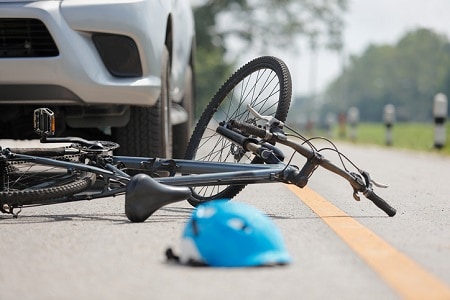
Cyclists riding in a designated bike lane in New York have the same legal status as any other vehicle operator on the road. VTL § 1231 grants every person riding a bicycle on a roadway all of the rights and all of the duties of a motor vehicle driver. That protection applies whether the cyclist is in a painted bike lane, a buffered lane, or sharing a travel lane with cars.
The Legal Definition of a Bike Lane
A bike lane under New York law is a portion of the roadway designated by striping, signage, and pavement markings for the preferential or exclusive use of bicycles. VTL § 102-a provides this definition. When a lane meets that standard, both cyclists and drivers have specific legal obligations tied to its use.
What Does "Due Care" Mean for Drivers Around Cyclists?
Due care means a driver must take every reasonable step to avoid hitting a cyclist on the road. VTL § 1146 places an affirmative duty on every driver to exercise due care to avoid colliding with any bicyclist on any roadway.
A driver who causes physical injury to a cyclist while failing to meet this standard faces a rebuttable presumption that their failure to use due care caused the injury. This statute applies throughout New York State, including every street and corridor in Buffalo.
How Is Fault Determined in a Bike Lane Accident in Buffalo?
Fault in a bike lane accident in Buffalo depends on which party violated traffic law and how each person's actions contributed to the collision. A driver who entered the bike lane without legal justification and struck a cyclist is typically at fault. However, insurance companies rarely concede that point without a fight.
Driver Behavior That Commonly Causes Bike Lane Crashes
Several patterns of driver negligence lead to bike lane collisions in Buffalo. These crash scenarios are among the most common types of bicycle accidents seen in bicycle accident claims across Erie County.
- Right-hook turns where a driver crosses through a bike lane to turn right at an intersection without yielding to a cyclist traveling straight
- Dooring incidents where a parked driver or passenger opens a vehicle door into the path of a cyclist in an adjacent bike lane
- Drifting or lane encroachment where a distracted or inattentive driver allows their vehicle to cross into the bike lane
- Illegal stopping or parking in a bike lane, forcing the cyclist into the travel lane where a second vehicle strikes them
Each of these scenarios involves a violation of one or more New York traffic statutes. Proving which violation occurred and connecting it to the crash is central to establishing liability.
Does Riding in the Bike Lane Automatically Prove the Driver Was at Fault?
No. Riding in the bike lane strengthens a cyclist's position, but it does not automatically prove the driver was at fault. The cyclist's own conduct matters.
Whether the cyclist was obeying traffic signals, riding in the correct direction, and remaining visible all factor into the fault analysis. New York's pure comparative negligence system means both parties' actions are evaluated, and fault may be split between them.
How Does Comparative Negligence Affect a Bike Lane Crash Claim?
New York allows an injured person to recover compensation even if they were partly responsible for the accident. The award is reduced by the injured person's percentage of fault.
This rule makes proving fault in a bike lane crash in NY especially important. The lower the cyclist's share of fault, the higher the potential recovery.
Ask William Mattar
Q: What happens if a car hits me while I'm in a bike lane in Buffalo?
A: A driver who strikes a cyclist lawfully riding in a designated bike lane may be liable for the cyclist's injuries under New York traffic law. The cyclist may recover compensation through the driver's liability insurance and through no-fault PIP benefits. The strength of the claim depends on proving the driver violated a traffic statute, failed to exercise due care, or both.
Q: What if the driver says I swerved out of the bike lane?
A: The driver's version of events does not control the outcome of the claim. Insurance companies may raise this argument, but countering it requires evidence: the police report, witness statements, physical evidence on the road, and any available video footage.
Q: Do I file an insurance claim with the driver's company or my own?
A: It depends. No-fault PIP benefits are filed with the insurance company of the vehicle that struck you. A separate liability claim for pain and suffering and damages beyond the PIP cap is also pursued against the driver's liability insurance. If the driver was uninsured, your own uninsured motorist coverage may apply.
What Other Laws Protect Cyclists on Buffalo Roads?
Beyond the due care and right-of-way statutes already discussed, several additional New York laws govern how drivers must interact with bicycles. These protections apply on every Buffalo street, from Delaware Avenue to Niagara Street to the corridors along the Olmsted parkway system.
Safe Passing Requirements Under VTL § 1122-a
VTL § 1122-a requires every driver overtaking a bicycle from behind to pass to the left at a safe distance until safely clear. New York does not currently define a specific minimum distance in feet. The standard is a "safe distance" based on the circumstances.
Anti-Dooring Protections Under VTL § 1214
New York law prohibits any person from opening a vehicle door on the traffic side of a street in a manner that interferes with the right of an approaching cyclist. VTL § 1214 applies to this scenario. Dooring crashes on streets with adjacent bike lanes are a frequent source of serious cycling injuries in Buffalo.
Bike Lane Use Requirements Under VTL § 1234
VTL § 1234 requires cyclists to ride in a usable bike lane when one is provided. However, cyclists may leave the bike lane when preparing for a left turn, avoiding unsafe conditions, or navigating around fixed or moving obstacles. A cyclist who leaves the lane for a legally recognized reason does not lose legal protection in a crash.
What Evidence Helps Prove Fault in a Bike Lane Crash in NY?
Strong evidence is what separates a clear-cut case from a disputed claim. Proving fault in a bike lane crash in NY often requires more documentation than people expect, especially when the insurance company challenges the cyclist's version of events.
Key categories of evidence in bicycle accident claims include the following:
- The police accident report, including any traffic citations issued to the driver at the scene
- Photos or video of the crash site showing bike lane markings, vehicle position, debris patterns, and road conditions
- Surveillance camera footage from nearby businesses, traffic cameras, or dashcam recordings
- Witness statements from pedestrians, other cyclists, or drivers who saw the collision
- Medical records linking specific injuries to the impact
Evidence collected soon after a crash is far more reliable than evidence gathered weeks or months later. Road conditions at the scene may change, witnesses may lose clarity on key details, and surveillance footage from nearby businesses is often overwritten within days.
Does the Serious Injury Threshold Apply to Bike Lane Crashes?
Yes. New York's serious injury threshold applies to every motor vehicle accident case, including bicycle crashes. Under Insurance Law § 5102(d), an injured cyclist must meet one of eight defined injury categories before pursuing pain and suffering damages beyond the no-fault PIP cap of $50,000.
Bicycle collisions often produce injuries that meet the threshold. Fractures, significant disfigurement, and permanent limitations of use are common outcomes when a vehicle strikes an unprotected cyclist, highlighting the risk of bicycle accidents. Objective medical documentation tying the injury to the crash is essential for satisfying the threshold.
No-fault PIP benefits still apply even if the threshold is not met. A cyclist struck by a motor vehicle in New York may file a no-fault claim with the insurance company of the vehicle that caused the collision.
PIP pays medical expenses, a portion of lost wages, and other necessary costs up to $50,000 regardless of who was at fault.
Bicycle Accident in a Bike Lane in Buffalo NY: Questions Answered by Our Attorneys
How long do I have to file a bicycle accident claim in Buffalo?
The general statute of limitations for a personal injury lawsuit in New York is three years from the date of the accident. However, no-fault PIP applications must be filed within 30 days. Notifying the at-fault driver's insurance carrier promptly also protects the claim from procedural challenges.
What if the bike lane was poorly maintained or missing markings?
A faded or poorly maintained bike lane may shift partial liability to the municipality responsible for road maintenance. Claims against a city or county entity in New York require a Notice of Claim within 90 days of the accident. These cases add complexity because they involve government immunity rules and shorter filing deadlines.
What types of compensation may be available after a bike lane crash?
Compensation in a bicycle accident claim may include medical expenses, lost wages, pain and suffering, and out-of-pocket costs tied to the injury. No-fault PIP covers economic losses up to $50,000. Pain and suffering damages are pursued through a separate liability claim against the at-fault driver, provided the cyclist meets the serious injury threshold. A Buffalo bicycle accident lawyer can help evaluate available compensation and determine which claims may apply.
Do bicycle accident cases go to trial in New York?
Most bicycle accident claims settle before trial. However, having an attorney prepared to take the case to trial may affect how the insurance company evaluates settlement offers. Cases involving disputed liability, serious injuries, or high damages are more likely to require litigation. A Buffalo personal injury lawyer can help prepare the case, negotiate with insurers, and pursue litigation when necessary.
When a Bike Lane Is Not Enough Protection, Call William Mattar

Bike lanes mark where cyclists belong on the road, but paint on pavement does not stop a distracted driver from crossing the line. Knowing your legal rights as a cyclist in Buffalo is the first step. Acting on those rights with the right evidence and the right legal strategy is what turns a strong position into fair compensation.
William Mattar handles bicycle accident claims for injured cyclists across Buffalo and Erie County. Call (716) 444-4444 for a free consultation. Our Buffalo bike accident lawyers know New York's bicycle safety laws and the insurance company arguments that follow a bike lane collision. We are available 24/7.