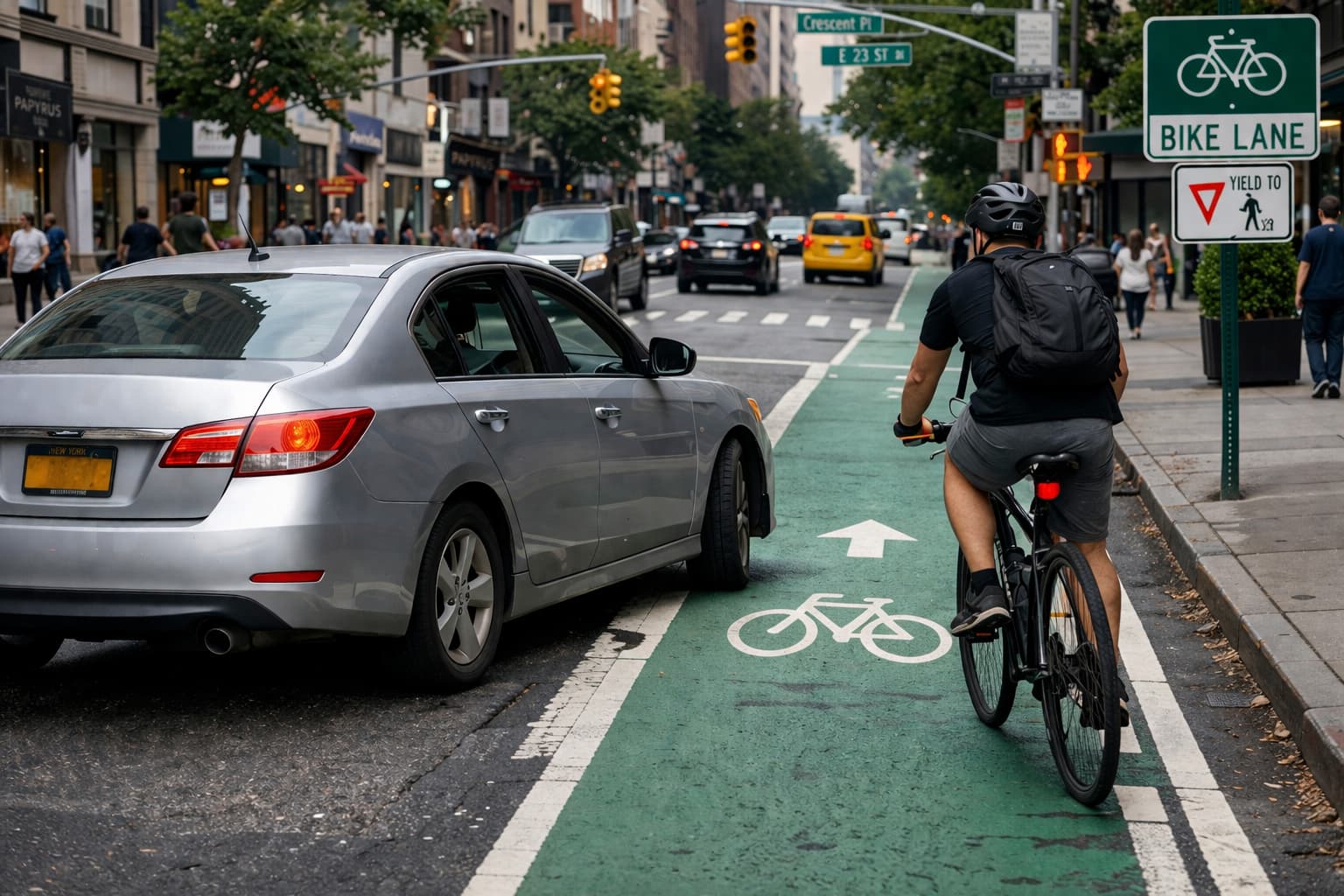
New York Vehicle and Traffic Law imposes specific duties on drivers when approaching, passing, or interacting with cyclists that go beyond the general duty of care owed to other motorists.
These duties can provide strong evidence of negligence in bicycle accident cases and counter narratives that cyclists don’t belong on roads or somehow forfeit their rights because of where they were riding.
New York law also grants cyclists the same rights and responsibilities as vehicle operators. The combination of these statutory protections can be crucial to your bicycle accident claim when drivers claim they "didn't see" you, argue you "came out of nowhere," or insist cyclists should stay off roads meant for cars.
Key Takeaways for Cyclist Right of Way New York Law
- VTL § 1146 requires drivers to “exercise due care to avoid colliding with any bicyclist” on roadways, creating a specific statutory duty that can be powerful evidence of negligence when a collision occurs
- VTL § 1231 grants cyclists "all of the rights and...all of the duties applicable to the driver of a vehicle," establishing that cyclists are lawful road users with the same right-of-way protections as motor vehicles at intersections and on roadways
- New York requires drivers to pass bicycles at a "safe distance" under VTL § 1122-a, though the statute doesn't specify a numeric distance—many municipalities and safety advocates use three feet as a practical benchmark for what constitutes safe passing clearance
- Common driver defenses like “I didn’t see the cyclist” or “bikes don’t belong on this road” can support a VTL § 1146 due-care argument, and VTL § 1231 road-rights argument, but liability still depends on the specific facts and evidence.
- VTL § 1146's "notwithstanding any other law" language means drivers must exercise due care to avoid colliding with cyclists even when cyclists violate traffic laws, limiting comparative fault defenses based solely on cyclist traffic violations
What Does VTL § 1146 "Due Care" Mean for Cyclists?
Vehicle and Traffic Law § 1146 states: "Notwithstanding the provisions of any other law to the contrary, every driver of a vehicle shall exercise due care to avoid colliding with any bicyclist, pedestrian, or domestic animal upon any roadway."
This statute creates several important legal protections:
Affirmative Duty Beyond General Negligence
Drivers don’t just have a duty to operate reasonably; they also have a specific statutory duty to exercise due care to avoid colliding with cyclists. In practice, a proven violation of this duty can strongly support a negligence claim, but the plaintiff still must prove the elements of negligence.
"Notwithstanding Any Other Law" Language
This phrase means the due care duty applies even when other traffic laws might seem to excuse the driver's conduct. For example, a driver can't argue they had a green light and therefore no duty to watch for cyclists crossing against the signal, VTL § 1146 still requires exercising due care to avoid collisions.
Creates Strong Evidence of Negligence
While VTL § 1146 violations aren't automatic negligence per se in the same way some traffic law violations are, courts treat these violations as powerful evidence of negligence. When drivers fail to maintain proper lookout, pass too closely, or turn across cyclists' paths, they can violate the statutory duty to exercise due care.
Do Cyclists Have the Same Right to the Road as Cars in New York?
Yes. VTL § 1231 establishes that "every person riding a bicycle...upon a roadway shall be granted all of the rights and shall be subject to all of the duties applicable to the driver of a vehicle" with specific exceptions that don't diminish cyclists' fundamental road rights.
This means:
- Right to use roadways — Cyclists can lawfully operate on most New York roadways, with limited exceptions for expressways and parkways where bicycle operation is specifically prohibited
- Right to full lane use — When necessary for safety or when the lane is too narrow for a bicycle and vehicle to travel safely side by side, cyclists can use the full lane rather than being forced to the edge
- Right to make left turns — Cyclists can execute left turns from the left lane at intersections, just as motor vehicles do, rather than being restricted to two-stage turns in all circumstances
- Protected by right-of-way rules — Cyclists traveling straight through intersections have the right of way over turning vehicles, and drivers must yield to cyclists who have entered intersections lawfully
The "same rights" language directly counters the defense that cyclists shouldn't be on roads or don't have the same protections as motor vehicles. When drivers argue "bikes don't belong here," VTL § 1231 provides the legal response: cyclists are lawful road users with full vehicle rights.
Does a Car Have to Give Me Three Feet When Passing in New York?
New York state law requires drivers to pass bicycles at a "safe distance" under VTL § 1122-a, which states vehicles overtaking bicycles "shall pass to the left thereof at a safe distance until safely clear thereof."
The statute doesn't specify a numeric distance, such as "three feet," at the statewide level. Rather, three feet is a practical benchmark. Many cycling safety advocates, law enforcement agencies, and local ordinances use three feet as the minimum safe passing distance. Some New York municipalities have enacted local laws requiring a three-foot passing distance, and proposed state legislation seeks to codify this standard statewide.
Context also determines what is “safe.” Factors affecting what distance qualifies include vehicle speed, road conditions, weather, traffic density, and whether the cyclist is traveling predictably in a straight line or making movements that require more clearance
Drivers who pass so closely that cyclists must brake, swerve, or take evasive action violate the safe distance requirement even when vehicles don't physically strike riders. These near-misses still create injury risks when cyclists crash trying to avoid vehicles passing unsafely.
Put simply, drivers must act in a reasonable manner when near bicycle riders as they are extremely vulnerable on the road.
How Does the Due Care Requirement Counter Common Driver Defenses?
Insurance companies and drivers defending bicycle accident claims raise predictable arguments. VTL § 1146's due care requirement directly counters these defenses:
Failure to Maintain Adequate Lookout
Drivers who claim they didn’t see cyclists often strengthen a due-care argument, but the evidence still has to show the driver failed to use reasonable care under the circumstances. The statute requires drivers to maintain proper lookout for cyclists, check blind spots, and scan for vulnerable road users before turning, changing lanes, or entering roadways. Failure to perceive a cyclist lawfully using the roadway demonstrates that the driver violated their statutory duty.
Sudden Appearance Arguments
Drivers may attempt to shift blame by claiming cyclists appeared unpredictably or suddenly. However, VTL § 1146 still requires drivers to exercise due care to avoid collisions, and that duty can be violated by inattention, speed, or unsafe maneuvers.
Improper Road Use Claims
VTL § 1231 grants cyclists the same rights as vehicle operators, making arguments about improper road use legally baseless. Unless the road is specifically closed to bicycle traffic (limited-access highways, certain bridges), cyclists have the legal right to use the roadway. Driver opinions about where cyclists should operate don't override statutory rights.
Who Has the Right of Way at Intersections for Bikes vs Cars in NY?
Intersection right-of-way rules apply equally to cyclists and motor vehicles because VTL § 1231 grants cyclists the same rights as vehicle drivers.
Right Hook Collisions: When Drivers Turn Right Across Cyclists' Paths
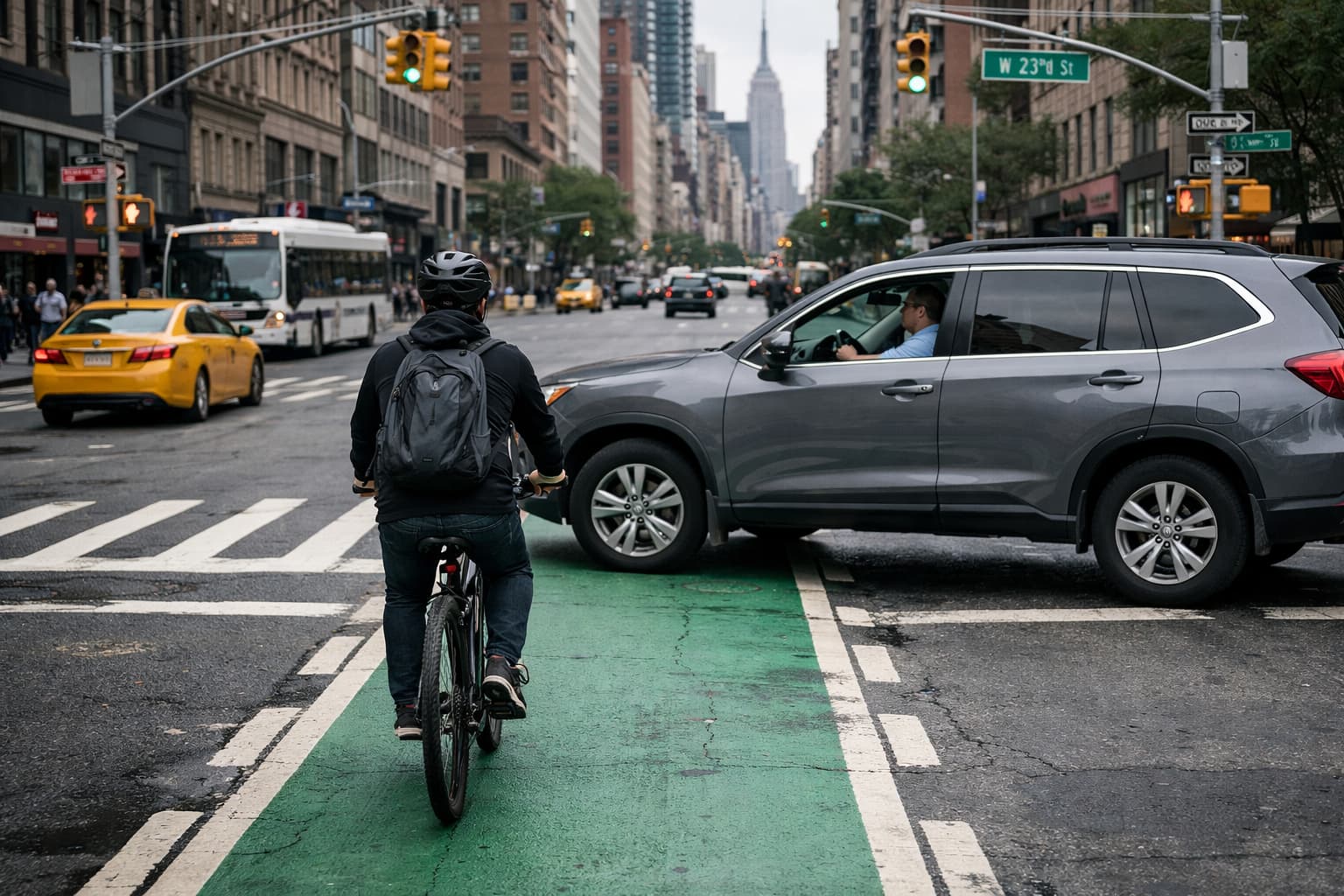
Right hook crashes occur when drivers turn right across cyclists' paths at intersections. Drivers either fail to see cyclists traveling in bike lanes or on the right side of the roadway, or misjudge their speed and attempt to complete turns before cyclists reach the intersection.
VTL § 1146 requires drivers to exercise due care to avoid these collisions by checking mirrors and blind spots before initiating right turns, yielding to cyclists who have entered the intersection or are too close for the driver to turn safely, and not accelerating to "beat" cyclists to the turn.
Left Cross Collisions: When Drivers Turn Left Into Oncoming Cyclists
Left cross crashes happen when drivers turning left at intersections fail to yield to oncoming cyclists who have the right of way traveling straight. Drivers often misjudge cyclists' speed, don't see cyclists at all, or assume they have time to complete the turn. These crashes directly violate both right-of-way rules and VTL § 1146's due care requirement because oncoming straight-through traffic, including cyclists, has the right of way over turning vehicles.
How William Mattar Handles Cyclist Right-of-Way Cases
Bicycle accident cases based on right-of-way violations and VTL § 1146 due care breaches require immediate evidence preservation and thorough investigation. Our attorneys work with injured cyclists throughout New York State to:
- Establish statutory violations — We can prove drivers violated VTL § 1146 by failing to exercise due care, violated VTL § 1122-a by passing at unsafe distances, or violated right-of-way rules at intersections
- Counter "cyclists don't belong" defenses — We use VTL § 1231 to establish your lawful right to use roadways and full lane rights, defeating arguments that you shouldn't have been where the crash occurred
- Preserve video evidence — We send preservation letters to secure traffic camera footage, business surveillance videos, and dashcam recordings before systems overwrite them
- Obtain legal professional analysis, when necessary — We work with accident reconstruction legal professionals who establish sight lines, reaction times, and whether drivers exercising due care would have avoided the collision
- Document damages — We calculate economic losses (medical bills, lost wages, bicycle replacement) and non-economic damages (pain and suffering, permanent injuries, reduced quality of life)
- Negotiate from strength — VTL § 1146 and § 1231 create powerful liability arguments that we use to negotiate fair settlements or present to juries when insurance companies refuse reasonable compensation
We handle cyclist right-of-way cases throughout New York State.
FAQ for Cyclist Right of Way New York Law
Can I recover damages if I was hit while riding in a bike lane?
Yes. Bike lanes provide designated space for cyclists, and drivers who enter bike lanes to park, turn, or travel violate traffic laws. VTL § 1146 requires drivers to exercise due care to avoid colliding with cyclists in bike lanes, making these crashes clear liability cases when drivers fail to check for cyclists before entering bike lane space.
What if I wasn't wearing a helmet or didn't have lights at night?
Failure to wear a helmet doesn’t bar injury claims (New York requires bicycle helmets for riders under 14, and helmet rules can also apply to certain e-bike riders, such as Class 3). However, insurance companies may argue you shared some of the blame for your injuries. VTL § 1146 still requires drivers to exercise due care, but comparative negligence may reduce recovery when equipment violations contributed to crashes.
Do I have to ride in the bike lane if one exists?
Not always. While VTL § 1234 requires cyclists to use bike lanes when available, exceptions apply when bike lanes are obstructed by parked cars, debris, or dangerous conditions; when preparing to make turns; or when the bike lane is unsafe due to surface conditions or other hazards. New York traffic law grants you the right to use the full lane when necessary for safety, and drivers still must exercise due care regardless of whether you're in the bike lane or the travel lane.
Can a driver be held liable if they had a green light when they hit me?
Yes. VTL § 1146’s ‘notwithstanding any other law’ language means drivers must exercise due care to avoid colliding with cyclists even when a cyclist may have violated a traffic law; cyclist violations can still be argued as comparative fault, but they don’t erase the driver’s due-care duty. Having a green light doesn't eliminate the statutory duty to watch for and avoid hitting cyclists.
New York Law Protects Cyclists and You Can Protect Your Injury Claim
The statutes exist. The duties are clear. But legal protections only work when someone enforces them against insurance companies that treat cyclist claims differently than motor vehicle claims.
Adjusters push quick settlements before you understand how the due care requirement shifts liability, or how equal road rights counter arguments about where you should have been riding. They hope you'll accept their narrative that the crash was unavoidable or that cyclists assume certain risks by being on the road.
Our bicycle accident attorneys in New York State turn statutory duties into accountability. We prove drivers violated their legal obligations, establish that your road position was lawful and protected, and pursue compensation that reflects the actual impact of your injuries. One consultation clarifies what happened legally versus what the insurance company wants you to believe happened.
Hit by a driver who claims you didn't have the right of way? Call William Mattar, P.C. today. Phones are answered 24/7. No Fee Until We Win.
Past performance does not guarantee future results, including financial results or client satisfaction.